











Based on the current SERP pattern and your reference pages, I’d target “Web 2.0 Submission Sites List 2027” as the main keyword. Below is a fresh InsightRob Media version built around informational intent rather than just publishing a thin backlink list.
If you are searching for a Web 2.0 submission sites list 2027, you are probably looking for free platforms where you can publish useful content, build your brand presence, earn referral traffic, and create relevant backlinks.
Web 2.0 link building, however, has changed considerably.
Creating hundreds of thin blogs, publishing duplicated articles, inserting exact-match anchor text, and abandoning the properties is no longer a sensible SEO strategy.
Google specifically identifies automated link creation and low-value content created mainly to manipulate linking and ranking signals as forms of link spam.
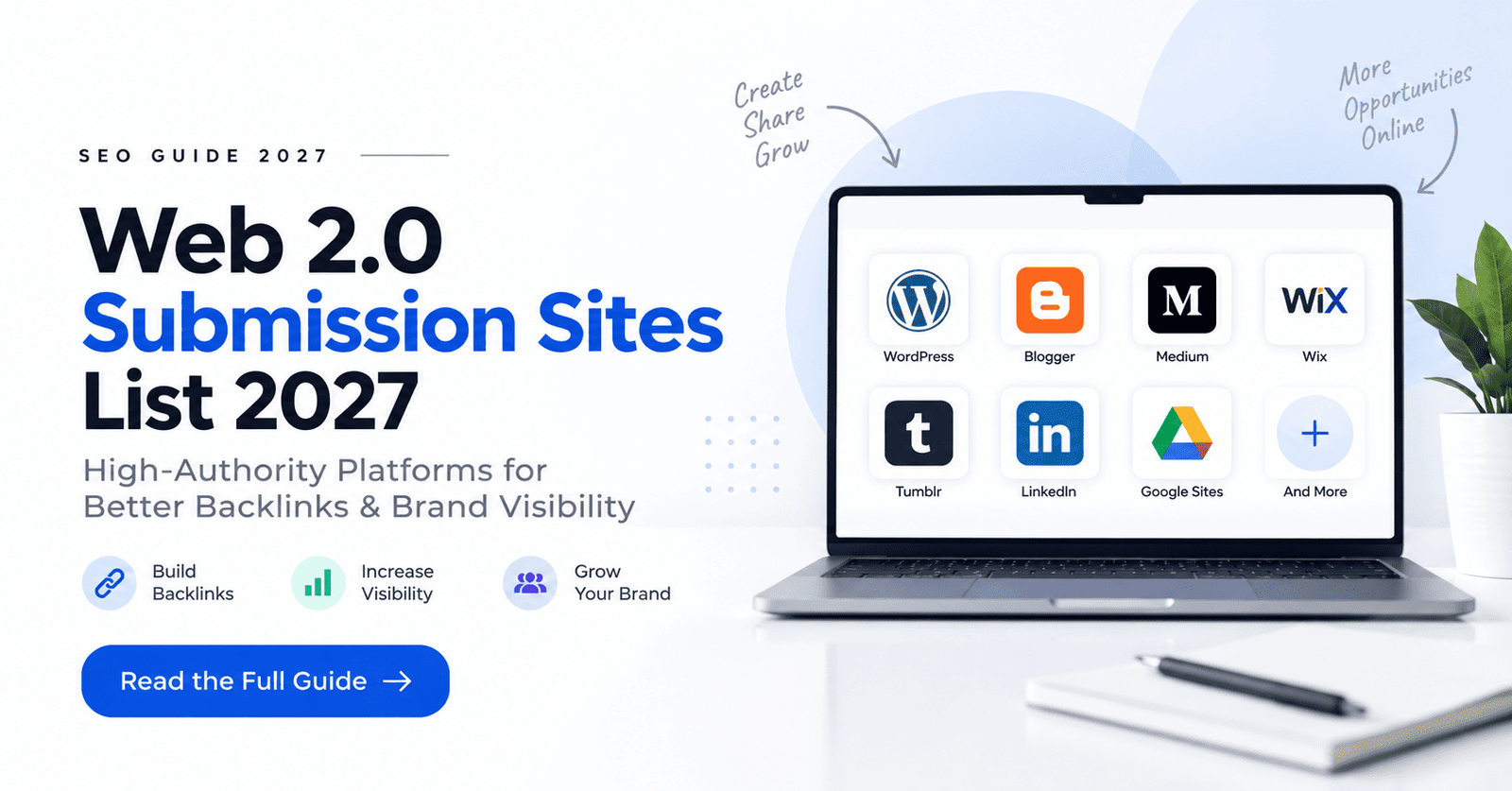
That does not mean platforms such as WordPress.com, Blogger, Medium, Tumblr, Wix, LinkedIn, Substack, and similar publishing websites are useless.
They can still be valuable when they are treated as real publishing and brand-distribution channels rather than backlink farms.
This guide covers:
- What Web 2.0 submission is
- Whether Web 2.0 backlinks still work in 2027
- 50+ Web 2.0 submission sites
- Best Web 2.0 platforms to prioritize
- How to create Web 2.0 backlinks correctly
- Anchor-text strategy
- Web 2.0 SEO mistakes
- Google-friendly link-building practices
- Web 2.0 strategies for AI search visibility
- A practical 30-day implementation plan
- Frequently asked questions
Quick Answer: What Are the Best Web 2.0 Submission Sites in 2027?
Some of the best-known Web 2.0 and user-publishing platforms for 2027 include:
WordPress.com, Blogger, Medium, Tumblr, Wix, Weebly, Substack, Google Sites, LinkedIn, GitHub Pages, Hashnode, DEV Community, LiveJournal, Strikingly, HubPages, Quora, Reddit, Behance, Issuu and SlideShare.
The right strategy is not to create an account on every available platform.
Instead, select a small number of relevant websites and publish genuinely useful content that supports your main website, expertise and brand.
Recent Web 2.0 resources have similarly shifted their recommendations toward maintaining a smaller number of genuine publishing properties instead of creating large networks of empty blogs.
What Are Web 2.0 Submission Sites?
Web 2.0 websites are online platforms where users can create, publish and interact with content.
Unlike the early web, where most websites primarily provided static information, Web 2.0 platforms allow users to create:
- Blogs
- Articles
- Profiles
- Mini websites
- Portfolios
- Communities
- Discussions
- Documents
- Presentations
- Videos
- Images
- Q&A content
For SEO professionals, Web 2.0 platforms became popular because many allow users to create their own pages and add links to relevant websites.
For example, instead of creating another independently hosted website, a business could publish useful educational content through a WordPress.com blog or Medium publication and naturally reference a detailed resource on its main website.
Are Web 2.0 Backlinks Still Useful in 2027?
Yes, but their purpose has changed.
A Web 2.0 backlink should not be viewed as a shortcut for increasing Google rankings.
Its value may come from several areas.
1. Brand Visibility
Publishing useful information across respected platforms can expose your business to users who may never discover your primary website directly.
2. Referral Traffic
A helpful Medium article, LinkedIn post, Reddit contribution or Quora answer can generate direct website visits.
3. Content Distribution
Web 2.0 platforms can help distribute research, case studies, tutorials, opinions and educational resources.
4. Topical Presence
Consistently discussing a subject across relevant publishing platforms can strengthen the broader online footprint surrounding a brand or author.
5. Natural Link Diversity
A genuine backlink profile normally contains different domains, anchor types and link attributes rather than hundreds of identical keyword-rich links.
6. Search and AI Discovery
Search engines and AI systems increasingly discover information across forums, communities, social platforms, publishing websites, documentation and other publicly accessible sources.
Therefore, Web 2.0 activity should increasingly focus on being useful and citable, not simply inserting links.
50+ Free Web 2.0 Submission Sites List for 2027
Platform policies, indexing rules and link attributes change regularly. Always verify the platform before investing significant effort.
| # | Web 2.0 Platform | Website | Best Use |
|---|---|---|---|
| 1 | WordPress.com | wordpress.com | Blogging |
| 2 | Blogger | blogger.com | Blogging |
| 3 | Medium | medium.com | Articles & thought leadership |
| 4 | Tumblr | tumblr.com | Microblogging |
| 5 | Wix | wix.com | Mini websites |
| 6 | Weebly | weebly.com | Websites & blogs |
| 7 | Google Sites | sites.google.com | Resource sites |
| 8 | Substack | substack.com | Articles & newsletters |
| 9 | LiveJournal | livejournal.com | Blogging |
| 10 | Ghost | ghost.org | Publishing |
| 11 | Hashnode | hashnode.com | Technology content |
| 12 | DEV Community | dev.to | Developer content |
| 13 | Write.as | write.as | Minimal publishing |
| 14 | Strikingly | strikingly.com | Mini websites |
| 15 | Jimdo | jimdo.com | Website publishing |
| 16 | Webflow | webflow.com | Websites |
| 17 | Yola | yola.com | Website creation |
| 18 | SITE123 | site123.com | Mini sites |
| 19 | Carrd | carrd.co | One-page resources |
| 20 | Notion | notion.so | Public resources |
| 21 | GitHub Pages | github.io | Technical content |
| 22 | GitLab Pages | gitlab.io | Developer resources |
| 23 | Behance | behance.net | Design portfolios |
| 24 | Dribbble | dribbble.com | Creative portfolios |
| 25 | Issuu | issuu.com | Publications |
| 26 | SlideShare | slideshare.net | Presentations |
| 27 | Telegraph | telegra.ph | Publishing |
| 28 | Canva | canva.com | Public visual resources |
| 29 | linkedin.com | Professional articles | |
| 30 | Quora | quora.com | Q&A |
| 31 | reddit.com | Communities | |
| 32 | pinterest.com | Visual discovery | |
| 33 | HubPages | hubpages.com | Articles |
| 34 | Vocal Media | vocal.media | Publishing |
| 35 | Steemit | steemit.com | Community publishing |
| 36 | Minds | minds.com | Social publishing |
| 37 | Diigo | diigo.com | Bookmarking & research |
| 38 | flipboard.com | Content curation | |
| 39 | Academia.edu | academia.edu | Academic documents |
| 40 | Instructables | instructables.com | Tutorials |
| 41 | Evernote | evernote.com | Public notes/resources |
| 42 | Hatena Blog | hatenablog.com | Blogging |
| 43 | xing.com | Professional presence | |
| 44 | uCoz | ucoz.com | Website building |
| 45 | Slashdot | slashdot.org | Technology community |
| 46 | FC2 Blog | blog.fc2.com | Blogging |
| 47 | Scribd | scribd.com | Documents |
| 48 | Calaméo | calameo.com | Digital publications |
| 49 | Zenodo | zenodo.org | Research resources |
| 50 | GitHub | github.com | Technical resources |
| 51 | Flickr | flickr.com | Image publishing |
| 52 | Pearltrees | pearltrees.com | Content curation |
| 53 | About.me | about.me | Personal/brand profiles |
| 54 | Wakelet | wakelet.com | Content collections |
| 55 | SoundCloud | soundcloud.com | Audio publishing |
Major current Web 2.0 lists consistently include platforms such as WordPress.com, Medium, Wix, Weebly, Blogger and other user-controlled publishing properties, although individual link attributes and account features can vary over time.
Best Web 2.0 Sites to Prioritize in 2027
Creating 50 accounts is usually unnecessary.
For most businesses, these platforms deserve consideration first.
1. WordPress.com
WordPress.com allows you to build a complete blog with categories, pages, posts, images and branding.
Best for:
- Industry blogs
- Educational articles
- Supporting content
- Brand publications
- Long-form guides
Instead of creating one article solely to obtain a backlink, develop a genuine niche publication.
2. Medium
Medium works particularly well for:
- Thought leadership
- Founder insights
- Industry opinions
- Research summaries
- Case studies
- Educational content
Medium should primarily be treated as an audience and content-distribution platform rather than a source of easy ranking links.
3. Blogger
Blogger remains one of the simplest ways to create a free blog.
Businesses can use it for supporting informational content, although your primary high-value content should normally remain on a website you control.
4. LinkedIn
For B2B companies, agencies, consultants and professionals, LinkedIn publishing can be far more valuable than creating dozens of unknown Web 2.0 blogs.
Publish:
- Industry observations
- Case studies
- Original research
- Professional advice
- Company insights
- Data-driven analysis
The objective should be building expertise and visibility.
5. Substack
Substack combines content publishing with newsletter distribution.
It can be particularly useful for:
- Founder newsletters
- Research updates
- Industry commentary
- Weekly reports
- Educational series
6. Hashnode
Hashnode is particularly relevant for:
- Developers
- SaaS brands
- Software companies
- Programming tutorials
- Technical SEO topics
- API documentation
A technically relevant platform is generally more useful than an unrelated high-authority website.
7. DEV Community
DEV is another strong option for businesses producing genuine technical content.
Suitable subjects include:
- Programming
- Development tutorials
- Open-source projects
- Software engineering
- APIs
- Cloud technology
- AI development
8. Google Sites
Google Sites can be used to organize genuinely useful supporting resources.
Examples include:
- Research collections
- Educational resources
- Event resources
- Project documentation
Avoid creating dozens of keyword-focused Google Sites purely for backlinks.
High DA Does Not Automatically Mean a High-Quality Backlink
This is one of the most important points for beginners.
If WordPress.com has strong domain-level metrics, your newly created page does not automatically inherit the ranking strength of the entire domain.
SEO tools such as Moz, Ahrefs and Semrush calculate third-party authority metrics differently.
Google does not use “DA” as its ranking metric.
Therefore, instead of asking:
“What is the DA of this website?”
Also ask:
- Is my page indexed?
- Is the content useful?
- Is the platform relevant?
- Does the page attract visitors?
- Does the profile look legitimate?
- Does the article have topical relevance?
- Is the backlink contextually appropriate?
A backlink placed on an abandoned page that nobody visits should not be treated as equivalent to an editorial reference within a useful article.
Dofollow vs Nofollow Web 2.0 Backlinks
You will frequently see Web 2.0 lists advertising:
“100% dofollow backlinks.”
Treat this claim carefully.
Platforms can change their outbound-link policies at any time.
Links may use:
dofollowor standard linksnofollowugcsponsored
Some platforms can also change attributes depending on where the link appears.
For example:
- Profile link
- Article link
- Comment
- Author bio
- Sponsored content
- User-generated section
Google explains that nofollow and sponsored attributes can be used to qualify appropriate outbound links.
Therefore, always check the actual published page rather than trusting an old SEO list.
How to Create Web 2.0 Backlinks Correctly in 2027
Step 1: Select Relevant Platforms
Do not choose websites solely because they have high DA.
Choose platforms that match your business.
For example:
SEO Agency
Consider:
- Medium
- WordPress
- Substack
- YouTube
- relevant Reddit communities
Software Company
Consider:
- GitHub
- Hashnode
- DEV
- Medium
- GitLab
Graphic Designer
Consider:
- Behance
- Dribbble
- Medium
Relevance should come before quantity.
Step 2: Complete the Profile Properly
Add genuine information including:
- Brand name
- Logo
- Description
- Website
- Author information
- Social profiles
- Expertise
- Contact information where appropriate
A completely empty profile containing only one backlink looks unnatural and provides little value to readers.
Step 3: Publish Original Content
Do not copy the same 1,000-word article across 20 platforms.
Create content specifically for each platform.
A strong Web 2.0 article should ideally answer a genuine question.
For example, instead of:
Best SEO Company in India – Click Here
write:
How Small Businesses Can Build an SEO Strategy in 2027
The second subject actually helps users.
Step 4: Create an Answer-First Introduction
AI search systems and modern search experiences increasingly benefit from clearly structured information.
Start important sections with a direct answer.
Example
What is Web 2.0 link building?
Web 2.0 link building involves publishing content on user-controlled platforms such as WordPress.com, Medium or Blogger and naturally referencing relevant resources from that content.
Then provide the deeper explanation.
This structure helps both users and machines understand the page quickly.
Step 5: Add Contextual Links
Links should appear because they genuinely help the reader.
Better Example
Businesses should also regularly audit technical problems that affect crawling and indexing. Our detailed technical SEO checklist explains the process.
Poor Example
Get the best SEO company in Chandigarh here.
The first link is contextual.
The second exists primarily for the keyword.
Step 6: Diversify Anchor Text
Avoid repeating the same keyword everywhere.
Instead, use a mixture such as:
Branded Anchor
InsightRob Media
Naked URL
insightrobmedia.com
Generic Anchor
read the complete guide
Partial-Match Anchor
guide to improving local SEO
Article-Title Anchor
Complete Local SEO Checklist for 2027
Natural variation is safer than repeating exact-match commercial keywords.
Recommended Anchor Text Distribution
There is no official Google percentage you must follow.
A natural backlink profile, however, will normally contain substantially more branded, URL and contextual anchors than aggressively optimized commercial anchors.
A practical approach might look like this:
| Anchor Type | General Approach |
|---|---|
| Brand Name | Use frequently |
| Naked URL | Use naturally |
| Article Title | Strong choice |
| Generic | Use where appropriate |
| Partial Match | Use moderately |
| Exact Match | Use cautiously |
Do not mechanically apply fixed percentages simply to make a backlink profile appear natural.
Step 7: Add Supporting Sources
A real article should not link only to your business.
Reference trustworthy sources when appropriate, including:
- Government websites
- Academic research
- Official documentation
- Industry organizations
- Original research
- Reputable publications
This makes the page more useful to readers.
Step 8: Add Original Media
Where the platform supports it, add:
- Images
- Charts
- Screenshots
- Tables
- Videos
- Infographics
- Examples
- Original data
Content becomes much stronger when it contributes information rather than merely rewriting existing articles.
Step 9: Maintain the Property
Do not create a blog, publish one article and disappear.
If a platform is worth using, consider publishing consistently.
Even one useful article every few weeks is better than dozens of abandoned profiles.
Step 10: Track the Results
Monitor whether Web 2.0 activity is actually helping.
Track:
- Referral traffic
- Indexed pages
- Brand searches
- Backlink discovery
- Leads
- Assisted conversions
- Engagement
- Traffic from individual platforms
Useful tools include:
- Google Analytics
- Google Search Console
- Ahrefs
- Semrush
- Moz
- Bing Webmaster Tools
Web 2.0 Strategy for Google and AI Search in 2027
SEO is increasingly about more than ranking ten blue links.
Businesses should think about their broader digital footprint.
Publish Information Worth Citing
Instead of publishing another generic article, create:
- Statistics
- Original research
- Industry surveys
- Case studies
- Comparisons
- Definitions
- Step-by-step processes
- Expert observations
- Templates
- Checklists
Content containing useful facts has a much stronger reason to be referenced.
Maintain Consistent Brand Information
Keep important entity information consistent where appropriate:
- Brand name
- Website
- Founder or author
- Business category
- Expertise
- Social profiles
This helps establish a clearer relationship between your brand and its online content.
Demonstrate Experience
Instead of writing:
SEO is important for businesses.
write something more concrete:
During a technical SEO audit, check indexing, canonicalization, redirect chains, Core Web Vitals, sitemap status and internal-link depth before beginning aggressive off-page work.
Specific information demonstrates more knowledge than generic filler.
Add Author Information
For important educational content, include:
- Author name
- Expertise
- Short biography
- Relevant experience
- Social or professional profile
Readers should understand who created the information.
Keep Content Updated
A list published in 2027 should not contain websites that shut down years earlier.
Review periodically:
- Registration availability
- Publishing functionality
- HTTPS
- Indexability
- Link policy
- Platform activity
One recent 2027-focused resource reported removing 14 of 56 tested platforms after finding them dead or unavailable, illustrating why older lists should not be trusted without verification.
Google-Friendly Web 2.0 Checklist
Before publishing, check the following:
| Check | Recommended |
|---|---|
| Original content | Yes |
| Helpful information | Yes |
| Relevant platform | Yes |
| Complete profile | Yes |
| Natural anchor text | Yes |
| Useful external sources | Yes |
| Multimedia | Where useful |
| Proper formatting | Yes |
| Exact-match keyword stuffing | No |
| Automated submissions | Avoid |
| Duplicate articles | Avoid |
| Hundreds of new properties | Avoid |
| Link-only pages | Avoid |
| AI-spun low-value content | Avoid |
Web 2.0 SEO Mistakes to Avoid in 2027
1. Mass Automated Submission
Google’s spam policies specifically list using automated programs or services to create links as an example of link spam.
Avoid creating hundreds of properties through automated tools.
2. Publishing Low-Quality AI Content
AI can help with:
- Research
- Outlining
- Editing
- Summarizing information
- Improving readability
But publishing hundreds of nearly identical pages purely to manipulate rankings is not a sustainable content strategy.
Human review and genuine value remain important.
3. Repeating Exact-Match Anchors
Do not repeatedly use:
- Best SEO company
- Best digital marketing agency
- Cheap web development company
Use branded and contextual references naturally.
4. Creating Backlinks From Irrelevant Sites
A website about healthcare should not create random content on unrelated platforms purely because a tool reports high DA.
Topical relevance matters.
5. Duplicate Content Across Every Platform
Publishing the exact same text everywhere creates little additional value.
When republishing is legitimate, use a platform’s available canonical or syndication features when appropriate.
6. Creating Thin Profiles
A username + backlink is not a content strategy.
Complete the profile and contribute something useful.
7. Obsessing Over DA
Third-party authority scores are helpful for analysis.
They should never be the only reason you create a backlink.
A Simple 30-Day Web 2.0 Strategy
Here is a practical approach for a small business.
Week 1 – Research
Select approximately 3–5 relevant publishing platforms.
Complete:
- Profiles
- Branding
- Descriptions
- Author information
- Website details
Plan at least five useful topics.
Week 2 – Content
Publish your first two strong articles.
Each article should contain:
- Clear search intent
- Original information
- Examples
- Relevant external citations
- Images where useful
- Natural links
Week 3 – Distribution
Share the articles through relevant:
- Social networks
- Communities
- Newsletters
- Internal resources
Avoid spammy link-dropping.
Week 4 – Evaluate
Check:
- Was the page indexed?
- Did anybody visit your website?
- Did the article receive engagement?
- Did branded search impressions increase?
- Is the platform worth maintaining?
Continue investing in platforms producing genuine value.
Web 2.0 vs Guest Posting vs Business Listings
| Strategy | Main Purpose | Content Required | SEO Value |
|---|---|---|---|
| Web 2.0 | Publishing & brand distribution | High | Supporting |
| Guest Posting | Editorial exposure | High | Potentially strong |
| Business Listings | Business/entity information | Low–Medium | Strong for local/entity consistency |
| Digital PR | Brand mentions & editorial links | Very High | Potentially strong |
| Forums/Q&A | Community participation | Medium | Referral & visibility |
| Social Profiles | Brand discovery | Low–Medium | Entity/brand presence |
A strong SEO campaign normally uses multiple legitimate channels rather than relying on a single backlink technique.
Should You Create 100 Web 2.0 Backlinks?
Usually, no.
The number itself is not a useful goal.
Creating five maintained properties with useful content can make far more sense than creating 100 abandoned profiles.
Ask:
Would I still publish this content if the link were nofollow?
If the answer is yes because the content provides visibility, traffic, credibility or audience value, you probably have a much healthier strategy.
Are Web 2.0 Sites Good for Local SEO?
They can support local SEO indirectly, but they should not replace the fundamentals.
Local businesses should prioritize:
- Google Business Profile optimization
- Accurate NAP information
- Local landing pages
- Customer reviews
- Local citations
- Local content
- Relevant local backlinks
- Strong technical SEO
Web 2.0 properties can then support informational content and brand visibility.
Are Web 2.0 Backlinks Good for New Websites?
They can be one component of an early SEO strategy.
New websites should focus first on:
- Technical setup
- Useful content
- Internal linking
- Search intent
- Indexing
- Business profiles
- Relevant citations
- Genuine outreach
After these foundations are established, selected Web 2.0 publishing platforms can support broader content distribution.
How Many Web 2.0 Sites Should You Create?
There is no official number.
For a small business, starting with 3–5 relevant platforms is usually more manageable than creating dozens.
For larger brands with dedicated content teams, more publishing channels may make sense.
The correct number is the number you can maintain with genuinely valuable content.
Frequently Asked Questions About Web 2.0 Submission Sites
What are Web 2.0 submission sites?
Web 2.0 submission sites are platforms where users can create and publish their own content, profiles, blogs, pages or resources. Examples include WordPress.com, Blogger, Medium, Tumblr and Wix.
Are Web 2.0 backlinks safe in 2027?
They can be when links occur naturally within useful, relevant content. Creating large numbers of low-value pages primarily to manipulate rankings can conflict with Google’s spam policies.
What are the best free Web 2.0 sites in 2027?
Popular options include WordPress.com, Medium, Blogger, Substack, Tumblr, Wix, Google Sites, LinkedIn, Hashnode and DEV Community. The best choice depends on your niche and audience.
Does Web 2.0 submission improve SEO?
It can support content distribution, referral traffic, online visibility and backlink diversity. It should not be treated as a guaranteed ranking technique.
Are Web 2.0 backlinks dofollow?
Some links may be standard links while others use nofollow, UGC or other attributes. Platform policies frequently change, so verify individual pages before categorizing a site.
Is Medium a Web 2.0 website?
Yes. Medium allows users to create accounts and publish their own articles, making it a typical example of a user-generated publishing platform.
Is Blogger still useful in 2027?
Blogger remains useful for creating free blogs, but businesses should treat it as a secondary publishing property rather than replacing their primary website.
How many Web 2.0 backlinks should I create per month?
There is no recommended Google-approved monthly number. Focus on quality, relevance and genuine publishing rather than backlink quotas.
Can Web 2.0 backlinks cause a Google penalty?
The platform itself is not the main issue. Risk increases when links are produced through manipulative techniques such as automation, low-value content, excessive exact-match anchor text or artificial link networks.
Can AI-generated articles be used on Web 2.0 websites?
AI can assist the content process, but articles should be reviewed, fact-checked and improved by humans. Avoid publishing large volumes of low-value content solely to obtain backlinks.
Should I use the same article on multiple Web 2.0 sites?
Creating original platform-specific content is generally the better approach. If legitimate syndication is used, follow the platform’s canonical or republishing options where available.
What is the difference between Web 2.0 and profile backlinks?
A profile backlink normally comes from an account or biography page. Web 2.0 publishing usually involves creating complete articles, pages, blogs or resources where links can appear in relevant context.
Does Domain Authority matter for Web 2.0 backlinks?
DA can be used as a third-party comparison metric, but it does not guarantee SEO value. Relevance, page quality, indexability, audience and contextual placement should also be considered.
Can Web 2.0 sites help with AI search visibility?
Useful content published across accessible authoritative platforms can increase the number of places where information about a brand or topic can be discovered. However, no platform can guarantee inclusion or citation by an AI search system.
The Web 2.0 submission sites list 2027 should not be treated as a list of websites where marketers can quickly drop hundreds of backlinks.
Modern Web 2.0 SEO works better when each platform is treated as a genuine publishing channel.
Prioritize:
Relevance over DA.
Original content over duplicated content.
Useful information over backlink placement.
Brand authority over exact-match anchor text.
A few maintained properties over hundreds of abandoned accounts.
Platforms such as WordPress, Medium, Blogger, Substack, LinkedIn, Hashnode and other publishing communities can still be useful when the objective is to educate users, distribute expertise and build a legitimate digital footprint.
If a Web 2.0 article would still be valuable even without its backlink, you are probably approaching the strategy correctly.