









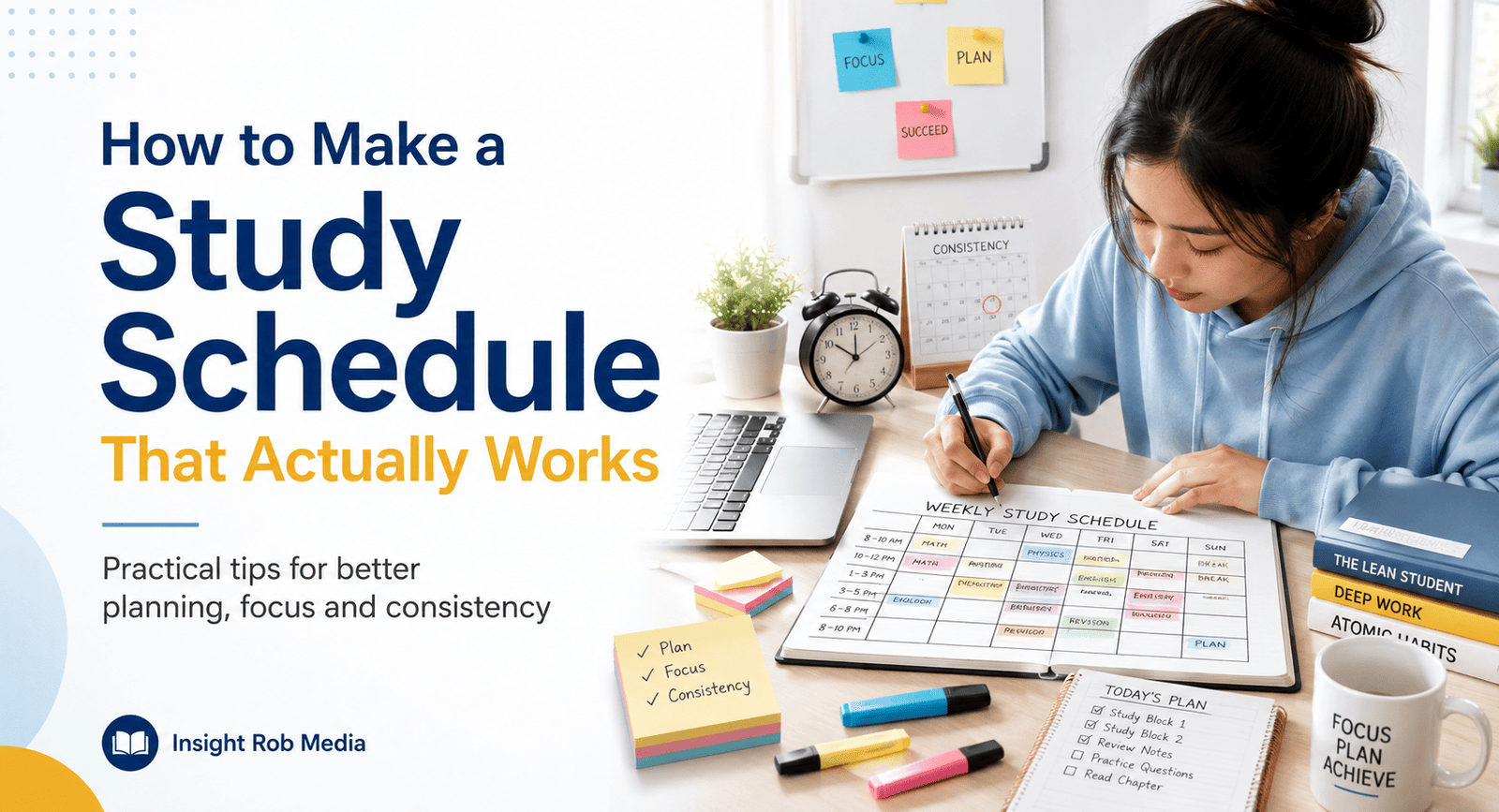


Creating a study schedule is easy. Following it consistently is the difficult part.
Many students design detailed timetables with long study hours, perfectly divided subjects, and almost no breaks. The plan may look impressive, but it often becomes impossible to follow after only a few days.
A practical timetable should fit your classes, sleep, energy, responsibilities, and academic goals. It should help you decide what to study without making every day feel stressful.
Learning how to make a study timetable is not about filling every available hour. It is about creating a flexible system that helps you complete important work on time.
This guide explains how to build a realistic study schedule, avoid common planning mistakes, and adjust your routine when circumstances change.
Why Most Study Timetables Fail
A timetable usually fails because it is created for an ideal day rather than a normal one.
Students often assume they will feel motivated, focused, and energetic every day. They forget about classes, travel, family responsibilities, tiredness, unexpected tasks, and difficult topics that take longer than expected.
Common reasons study schedules fail include:
- Planning too many hours
- Ignoring sleep and rest
- Giving every subject equal time
- Creating vague tasks
- Adding no buffer time
- Studying without clear priorities
- Copying another student’s routine
- Refusing to adjust the schedule
- Trying to follow every minute perfectly
A successful schedule should provide direction without becoming a source of guilt.
How to Make a Study Timetable That Fits Your Life
Step 1: List All Your Fixed Commitments
Before adding study sessions, write down the activities that already have fixed timings.
These may include:
- School or college classes
- Coaching sessions
- Work hours
- Travel time
- Meals
- Exercise
- Household responsibilities
- Religious or community activities
- Sleep
- Regular appointments
This step shows how much time is genuinely available.
Do not calculate your study time by subtracting classes from 24 hours. Sleep, meals, travel, rest, and personal responsibilities also require space.
A timetable becomes realistic only when it begins with your actual life.
Step 2: Set Clear Academic Goals
Your schedule should be connected to specific outcomes.
A goal such as “study more” is difficult to plan. Instead, define what you need to achieve.
Examples include:
- Complete the mathematics syllabus before 20 September
- Revise two biology chapters each week
- Finish an assignment three days before the deadline
- Solve one previous exam paper every Sunday
- Improve vocabulary by learning 15 words daily
- Complete all class notes before monthly tests
Separate long-term goals from weekly tasks.
A long-term goal tells you where you want to go. A weekly task tells you what to do next.
Step 3: Identify Your Available Study Hours
Look at your weekly calendar and mark the periods that can realistically be used for studying.
You might have:
- One hour before school
- Two hours after college
- A longer session on Saturday
- Short revision time during travel
- Thirty minutes before dinner
- Two focused sessions on Sunday
Do not use every free minute.
Leave some space for rest, unexpected work, and activities you enjoy. A schedule that removes all personal time will become difficult to maintain.
Step 4: Understand Your Energy Levels
Not every hour is equally productive.
Some students focus better early in the morning. Others work best in the afternoon or evening.
Track your energy for a few days and notice when you feel:
- Most alert
- Moderately focused
- Easily distracted
- Mentally tired
Use your strongest periods for difficult tasks.
For example:
- Solve mathematics problems when your focus is highest.
- Read an easier chapter during a lower-energy period.
- Review flashcards when you have only 15 minutes.
- Organise notes when you feel too tired for deep learning.
This makes your schedule more efficient without increasing total study time.
Step 5: Prioritise Subjects Properly
Do not divide your time equally unless every subject has the same difficulty, importance, and deadline.
Give more time to subjects that:
- Carry greater marks
- Have an approaching examination
- You find difficult
- Require regular practice
- Have incomplete notes
- Include large assignments
- Are important for your future course or career
You can use three priority levels:
High Priority
Difficult subjects, urgent deadlines, or high-weightage topics.
Medium Priority
Subjects that need regular revision but are under control.
Low Priority
Topics that are easier, familiar, or less urgent.
Review these priorities each week because they may change.
Step 6: Break Large Subjects Into Small Tasks
“Study science” is not a useful timetable entry.
It is too broad and does not tell you what to complete.
Write specific tasks such as:
- Read Chapter 6, pages 80–92
- Make notes on photosynthesis
- Solve questions 1–15
- Revise chemical equations
- Complete one practice test
- Learn five definitions
- Review yesterday’s mistakes
Specific tasks reduce confusion and make progress easier to measure.
This is an essential part of learning how to make a study timetable that produces real results.
Step 7: Choose a Suitable Study Session Length
Your ideal session length depends on the subject and your concentration.
Common options include:
25-Minute Sessions
Study for 25 minutes and rest for 5 minutes. This can help when you struggle to begin or become distracted easily.
40-Minute Sessions
Study for 40 minutes and take a 10-minute break. This works well for reading, revision, and moderate practice.
50-Minute Sessions
Study for 50 minutes and rest for 10 minutes. This may suit older students or learners with stronger concentration.
90-Minute Sessions
Long sessions may work for practice papers, assignments, or deep project work. However, they require proper breaks and should not be used for every task.
Start with a duration you can manage consistently. You can increase it later.
Step 8: Add Breaks Before You Need Them
Breaks are not wasted time. They help you return with better attention.
Include short breaks between focused sessions and longer breaks after several study blocks.
During a useful break, you can:
- Drink water
- Stretch
- Walk
- Eat a light snack
- Rest your eyes
- Step outside
- Take a few slow breaths
Avoid opening social media during every break. A five-minute break can easily become a long distraction.
Set a timer when necessary.
Step 9: Include Revision in the Timetable
Many schedules focus only on new chapters and forget revision.
Without planned review, students may understand a topic initially but struggle to remember it later.
Include revision at different intervals:
- Quick review on the same day
- Short review after two or three days
- Weekly revision
- Monthly subject review
- Practice before examinations
You can reserve the last 10 minutes of a study session for recalling what you learned.
You can also schedule one weekly revision block for important formulas, definitions, diagrams, and mistakes.
Step 10: Add Buffer Time
Tasks do not always finish within the planned period.
A difficult chapter may take longer. An assignment may require additional research. You may also miss a session because of illness, travel, or another responsibility.
Add one or two buffer periods each week.
Use this time to:
- Complete unfinished work
- Revise weak topics
- Prepare for an unexpected test
- Catch up after a missed session
- Organise the following week
When no catch-up work is required, the buffer can become free time.
Step 11: Keep One Day Lighter
Studying intensely every day can create exhaustion.
Choose one lighter day each week. You can still review notes or plan upcoming work, but avoid filling the entire day with demanding tasks.
A lighter day can include:
- Flashcard revision
- Organising notes
- Watching an educational lesson
- Reviewing completed work
- Planning the next week
- Resting after essential tasks
Rest supports consistency. It is not a reward that must be earned through exhaustion.
Step 12: Review the Timetable Every Week
A study timetable is not a permanent document.
At the end of each week, ask:
- Which sessions did I complete?
- Which tasks took longer than expected?
- When was my focus strongest?
- Which subjects need more time?
- What caused missed sessions?
- Is the schedule affecting my sleep?
- What should I change next week?
Adjust the plan based on real experience.
A timetable that changes with your needs is more useful than a perfect-looking schedule that you cannot follow.
Sample Daily Study Timetable for School Students
Here is a simple example for a student who returns home in the afternoon:
4:00–4:30 PM: Snack and rest
4:30–5:10 PM: Complete homework
5:10–5:20 PM: Break
5:20–6:00 PM: Difficult subject practice
6:00–6:30 PM: Outdoor activity or rest
6:30–7:10 PM: Revise one theory subject
7:10–8:00 PM: Dinner and family time
8:00–8:30 PM: Review notes or flashcards
8:30–8:40 PM: Plan tomorrow’s tasks
This is only an example. Travel, coaching, family routines, and school timings may require changes.
Sample Study Timetable for College Students
7:00–7:45 AM: Review yesterday’s lecture
9:00 AM–3:00 PM: Classes and college activities
4:00–5:00 PM: Rest, meal, or travel
5:00–5:50 PM: Assignment or project work
5:50–6:10 PM: Break
6:10–7:00 PM: Difficult subject
7:00–8:00 PM: Dinner and personal time
8:00–8:40 PM: Reading or revision
8:40–8:50 PM: Prepare next day’s materials
College students should also schedule longer blocks for research, practical work, and group projects.
Sample Weekend Study Schedule
Weekends are useful for longer tasks, but they should not become exhausting.
8:00–9:00 AM: Weekly revision
9:00–9:30 AM: Breakfast
9:30–10:30 AM: Practice paper
10:30–11:00 AM: Break
11:00 AM–12:00 PM: Review mistakes
Afternoon: Personal activities or rest
5:00–5:45 PM: Assignment work
6:00–6:30 PM: Plan the next week
A balanced weekend schedule leaves time for family, exercise, hobbies, and proper rest.
How to Create an Exam Study Timetable
An exam timetable should focus more heavily on revision, practice, and weak areas.
Begin by listing:
- Exam dates
- Remaining chapters
- Important topics
- High-weightage sections
- Weak subjects
- Practice papers
- Revision requirements
Then count the available study days.
Divide topics across those days, but keep the final few days mainly for revision and practice.
Avoid learning large amounts of completely new material immediately before the exam when possible.
A useful exam plan might include:
- Morning: difficult subject
- Afternoon: practice questions
- Evening: theory revision
- Night: formulas or flashcards
Do not schedule every subject every day. Too much switching can reduce concentration.
Digital vs Paper Study Timetable
Both options can work.
Paper Timetable
A paper schedule is simple, visible, and free from digital distractions. You can place it near your desk.
Digital Timetable
Calendar applications and planning tools make it easier to set reminders, move sessions, and repeat weekly tasks.
Choose the method you will check regularly.
You can also combine both. Keep major study blocks in a digital calendar and write daily tasks on paper.
Common Study Timetable Mistakes
Planning Excessive Study Hours
Long schedules often look productive but lead to tiredness and missed sessions.
Ignoring Difficult Subjects
Students sometimes spend more time on subjects they already enjoy. Your timetable should also address weak areas.
Leaving Tasks Too Vague
Write what you will complete, not only the subject name.
Creating No Time for Revision
New learning without review can reduce long-term recall.
Studying Without Breaks
Continuous study can reduce attention and make the schedule harder to maintain.
Changing the Schedule Every Day
Some flexibility is useful. However, constant changes can prevent routines from developing.
Giving Up After One Bad Day
Missing one session does not mean the entire timetable has failed. Use buffer time and continue.
Study Timetable Checklist
Before using your schedule, confirm that it includes:
- Fixed classes and responsibilities
- Sufficient sleep
- Clear academic goals
- Specific study tasks
- Difficult subjects during high-energy periods
- Regular breaks
- Weekly revision
- Buffer time
- Exercise or movement
- Personal and family time
- A weekly review period
Frequently Asked Questions
How do I make a study timetable for myself?
Begin by listing fixed commitments, available study hours, academic goals, and subject priorities. Then create specific study blocks with breaks, revision, and buffer time.
How many hours should I study each day?
There is no single correct number. The ideal duration depends on your age, classes, deadlines, concentration, and goals. Focused study for a shorter period can be more useful than long, distracted sessions.
What is the best time to study?
The best time is when your energy and concentration are strongest. Some students focus better in the morning, while others prefer the afternoon or evening.
How can I follow my study timetable consistently?
Keep it realistic, use specific tasks, remove major distractions, and review progress weekly. Avoid planning more work than you can reasonably complete.
Should I study every subject daily?
Not necessarily. Some subjects require frequent practice, while others can be studied on selected days. Divide time according to difficulty, urgency, and importance.
How do I make a study timetable before exams?
List exam dates and remaining topics. Prioritise weak and high-weightage areas, schedule practice papers, and reserve the final days for revision.
What should I do when I miss a study session?
Move the unfinished task to your next buffer period. Do not overload the following day or abandon the whole schedule.
Final Thoughts
Learning how to make a study timetable is about creating a routine that supports progress without controlling every minute of your day.
Begin with your real commitments, identify your strongest study periods, and divide subjects according to importance. Use specific tasks instead of vague instructions, and include breaks, revision, and buffer time.
Most importantly, review your timetable regularly. A useful schedule should change when your subjects, deadlines, or responsibilities change.
Do not aim for a perfect week. Aim for a routine you can return to after a difficult day.
Start by planning the next seven days. Keep the schedule simple, test it honestly, and improve it based on what actually works.
For more practical study, education, productivity, and student-life guides, explore Insight Rob Media.