











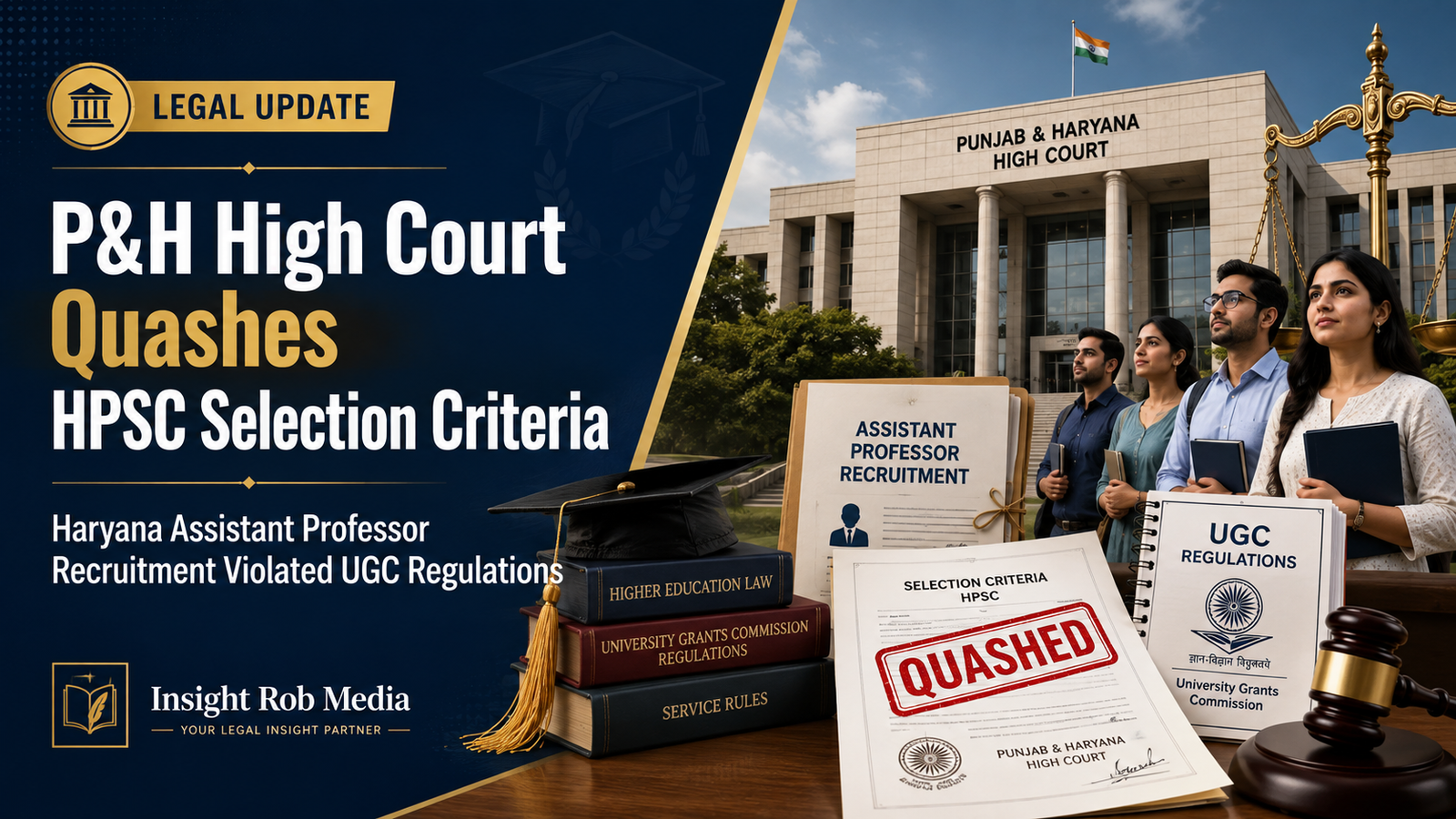
The Punjab and Haryana High Court has set aside the Haryana Public Service Commission’s recruitment process for 613 Assistant Professor (English) posts in government colleges.
The Court held that Haryana and HPSC could not replace the recruitment procedure prescribed under the UGC Regulations, 2018 with a screening examination, subject knowledge test and interview-based selection formula.
The judgment was delivered on May 12, 2026, by Justice Tribhuvan Dahiya in Asha Rani and Others v. State of Haryana and Others, CWP-661-2026, along with connected petitions. The Court directed the authorities to conduct the Assistant Professor selection process afresh and strictly follow the UGC Regulations.
This article has also been prepared with reference to the legal update published by LaWGiCo under the title “Haryana’s Assistant Professor Recruitment Process Illegal for Violating UGC Regulations: Punjab & Haryana High Court Quashes Selection Criteria Framed by HPSC.”
Key Details of the Haryana Assistant Professor Recruitment Case
Case name: Asha Rani and Others v. State of Haryana and Others
Case number: CWP-661-2026 and connected matters
Date of decision: May 12, 2026
Court: Punjab and Haryana High Court
Bench: Justice Tribhuvan Dahiya
Recruitment concerned: Assistant Professor (English), College Cadre
Advertisement: HPSC Advertisement No. 48 of 2024
Number of posts: 613
Although the original petitions referred to Advertisement Nos. 42 to 67 of 2024, the candidates restricted their challenge during the hearing to Advertisement No. 48 of 2024, which concerned Assistant Professor posts in English.
Background of the Recruitment Dispute
The Haryana Higher Education Department sent a requisition to HPSC for filling 613 Assistant Professor posts in English under the College Cadre.
HPSC subsequently issued Advertisement No. 48 of 2024 and invited applications from eligible candidates. The Commission prescribed a multi-stage examination process consisting of a screening test, a subject knowledge test and an interview.
Several candidates participated in the recruitment and cleared the screening examination. However, they were unsuccessful in the subject knowledge test conducted on August 17, 2025.
The candidates then approached the Punjab and Haryana High Court. They challenged the Haryana Government’s memorandum dated November 11, 2022, and the selection procedure followed by HPSC.
Their main argument was that the State and HPSC had replaced the mandatory UGC selection framework with a completely different examination-based system.
Selection Process Prescribed by HPSC
Under HPSC’s disputed recruitment system, candidates were required to pass three stages.
1. Screening Test
The first stage consisted of 100 multiple-choice questions carrying 100 marks. Candidates generally needed to secure at least 25% marks.
Based on the screening test result, candidates numbering approximately four times the advertised vacancies were to be called for the next stage. Marks obtained in the screening test were not added to the final merit score.
2. Subject Knowledge Test
The second stage was a three-hour subject knowledge examination carrying 150 marks.
Candidates were required to secure at least 35% marks. Candidates numbering approximately twice the available vacancies could then be called for the interview.
3. Interview and Final Merit
The subject knowledge test carried 87.5% weightage, while the interview carried only 12.5% weightage.
The final merit list was to be prepared by combining the marks obtained in the subject knowledge test and interview.
The petitioners argued that this system was fundamentally different from the process prescribed under the UGC Regulations, 2018.
What Do the UGC Regulations Require?
The UGC Regulations on minimum qualifications and appointment of teaching staff were notified on July 18, 2018.
They apply to universities and recognised constituent or affiliated colleges and prescribe minimum qualifications and appointment standards intended to maintain the quality of higher education.
For direct recruitment of Assistant Professors, the Regulations provide a connected framework covering:
- Minimum eligibility and academic qualifications.
- Shortlisting based on academic scores.
- Constitution of the selection committee.
- Interview and final selection procedure.
The Punjab and Haryana High Court held that Regulations 4, 5 and 6 could not be separated from one another. Together, they formed a single and composite recruitment framework.
Academic Scores Must Be Used for Shortlisting
Under the UGC framework considered by the High Court, candidates for Assistant Professor posts must be shortlisted using the academic score criteria specified in Appendix II, Table 3B.
The academic assessment may include marks or weightage for:
- Graduation and postgraduate qualifications.
- M.Phil. or Ph.D. qualifications.
- NET, JRF, SET or SLET.
- Research publications.
- Teaching or postdoctoral experience.
- Academic awards.
After candidates are shortlisted through the prescribed academic scoring system, their final selection must be based on interview performance as required by the Regulations.
HPSC, however, replaced this academic-score-based shortlisting system with a screening test. It then based final selection primarily on the subject knowledge examination.
The High Court found that the Haryana recruitment method did not merely add a higher qualification or stricter standard. Instead, it created an entirely different method of shortlisting and selection.
Haryana Government’s Memorandum of November 11, 2022
The dispute also centred on a memorandum issued by the Haryana Government on November 11, 2022.
Through this memorandum, Haryana claimed to adopt the UGC Regulations with certain modifications. The modified framework allowed recruitment in government colleges through HPSC according to criteria determined by the State Government and the Commission.
HPSC then framed its own examination scheme under this authority.
The High Court observed that Haryana had selectively adopted parts of the UGC Regulations while removing or changing essential provisions related to shortlisting, selection committees and final selection.
State Government’s Arguments
The Haryana Government defended the recruitment process by arguing that the UGC Regulations were not automatically binding on the State.
It contended that Haryana had the authority to adopt the Regulations with appropriate modifications. The State also argued that it could prescribe its own direct recruitment system for teachers appointed to government colleges.
Another argument was that the UGC framework was directory rather than mandatory for the State, particularly where the State was not receiving financial assistance from the UGC.
HPSC maintained that its screening and subject knowledge tests created an effective and merit-based system for assessing candidates.
UGC Recruitment Standards Cannot Be Selectively Adopted
The High Court rejected the contention that the State could choose which portions of the UGC Regulations it wanted to follow.
Justice Tribhuvan Dahiya held that Regulations 4, 5 and 6 formed one composite whole. Separating one part from the rest would dismantle the scheme and undermine the minimum standards established for higher education recruitment.
The Court observed that the UGC framework covers not only the minimum educational qualifications of a candidate but also the manner in which eligible candidates must be shortlisted and selected.
Therefore, Haryana could not retain the UGC’s eligibility requirements while replacing its shortlisting and selection process with HPSC’s examination pattern.
Importance of Entry 66 of the Union List
The High Court examined the constitutional position of the UGC Regulations.
Entry 66 of List I of the Seventh Schedule to the Constitution gives Parliament authority over the coordination and determination of standards in institutions of higher education.
The Court found that the UGC Regulations were connected with maintaining minimum national standards for universities and colleges. States and universities could not conduct teacher recruitment in a manner that violated those prescribed standards.
The judgment does not suggest that a State can never prescribe a higher standard. However, a State cannot introduce a system that dilutes, contradicts or replaces the mandatory recruitment framework established by the UGC.
The Court found that HPSC’s examination system was an alternative procedure rather than a valid higher standard.
Supreme Court Decisions Considered by the High Court
The High Court referred to the Supreme Court’s judgment in Mandeep Singh v. State of Punjab, which examined the effect of UGC recruitment regulations on appointments to teaching posts.
It also considered the principles discussed in Dr. S. Mohan v. The Secretary to the Chancellor, Puducherry Technological University.
The Court observed that standards prescribed through UGC Regulations could not be bypassed through inconsistent State rules or executive instructions.
These principles supported the conclusion that Haryana’s November 2022 memorandum could not legally alter the integrated recruitment process prescribed under the 2018 Regulations.
Can Candidates Challenge a Process After Participating in It?
The State and HPSC argued that the petitioners had already participated in the screening test and subject knowledge test.
According to the respondents, unsuccessful candidates could not challenge the selection criteria after taking part in the recruitment.
The High Court rejected this objection.
It explained that participation in a selection process may prevent a candidate from challenging a procedure merely because the result was unfavourable. However, participation does not prevent a candidate from challenging an inherent illegality or violation of mandatory statutory provisions.
A candidate accepts the prescribed process by participating in it. The candidate does not accept an unlawful departure from binding recruitment rules.
Therefore, the candidates were entitled to question HPSC’s process even though they had appeared in the examinations.
Final Order of the Punjab and Haryana High Court
The Court declared the Haryana Government memorandum dated November 11, 2022, unlawful and set it aside to the extent that it violated Regulations 4, 5 and 6 of the UGC Regulations, 2018.
As a consequence, the recruitment process conducted under Advertisement No. 48 of 2024 was also declared invalid.
The Court issued the following principal directions:
- The selection process for Assistant Professor (English) posts under Advertisement No. 48 of 2024 was set aside.
- Advertisement No. 48 of 2024 was also set aside.
- Haryana and HPSC were directed to conduct the selection process afresh.
- The fresh selection must strictly comply with the UGC Regulations, 2018.
- The authorities were directed to complete the fresh recruitment process expeditiously.
Does the Judgment Cancel Recruitment for Every Subject?
The original HPSC recruitment exercise covered Assistant Professor posts in several subjects through Advertisement Nos. 42 to 67 of 2024.
However, during the hearing, the petitioners specifically restricted their challenge to Advertisement No. 48 of 2024 concerning Assistant Professor posts in English.
Therefore, the operative order directly sets aside the recruitment for Assistant Professor (English) posts under Advertisement No. 48 of 2024. It should not automatically be described as cancelling every Assistant Professor recruitment conducted for all subjects.
Nevertheless, the Court’s interpretation of the UGC Regulations may be relevant to other recruitment processes based on the same November 2022 memorandum. The effect on another subject would depend on the relevant advertisement, stage of selection and any separate court proceedings.
What Does the Judgment Mean for Candidates?
Candidates who applied under Advertisement No. 48 of 2024 will not receive appointments based on the selection procedure that has been set aside.
Haryana and HPSC must begin a fresh selection process that follows the academic shortlisting and selection framework prescribed by the UGC.
The judgment does not grant automatic appointment to any petitioner. It also does not declare any individual candidate selected.
Every eligible candidate will have to participate in the fresh process according to the conditions notified by the authorities and the UGC Regulations.
Candidates should preserve their application forms, fee receipts, qualification records, experience certificates, NET or SET documents, research details and other academic records that may be relevant to the UGC academic score.
Why the Decision Is Significant
The judgment reinforces the role of the UGC in maintaining uniform minimum standards in higher education.
Recruiting an Assistant Professor does not involve eligibility alone. The shortlisting method, selection committee and final assessment procedure also affect the academic quality of appointments.
The High Court held that these elements form an integrated system. A State cannot adopt the qualification requirements from the UGC framework while discarding the selection method connected with those requirements.
The decision also protects the right of candidates to challenge public recruitment procedures that violate binding legal standards.
Conclusion
The Punjab and Haryana High Court has declared Haryana’s Assistant Professor (English) recruitment process unlawful because it departed from the UGC Regulations, 2018.
The Court found that HPSC’s screening test, subject knowledge examination and weighted interview formula replaced the academic-score-based shortlisting and selection procedure prescribed by the UGC.
It consequently set aside Advertisement No. 48 of 2024 and the selection process conducted under it.
Haryana and HPSC must now restart the recruitment process and complete it expeditiously in strict compliance with the UGC framework.
The judgment is an important reminder that State Governments and recruitment commissions cannot selectively adopt central higher-education standards or alter their essential components through executive instructions.
Frequently Asked Questions
Which Haryana Assistant Professor recruitment was quashed?
The Court quashed the recruitment process for 613 Assistant Professor (English) posts conducted under HPSC Advertisement No. 48 of 2024.
Why was HPSC’s selection process declared illegal?
HPSC replaced the UGC-prescribed academic-score shortlisting and selection procedure with a screening test, subject knowledge test and interview formula. The Court held that this change violated Regulations 4, 5 and 6 of the UGC Regulations, 2018.
What weightage did HPSC give to the subject knowledge test?
The subject knowledge test carried 87.5% weightage, while the interview carried 12.5% weightage in the final merit list.
Will HPSC conduct the recruitment again?
The High Court directed Haryana and HPSC to conduct a fresh selection process strictly according to the UGC Regulations and complete it expeditiously.
Were the petitioners automatically selected?
No. The judgment only set aside the unlawful process. It did not order the automatic appointment of any candidate.
Could candidates challenge the recruitment after appearing in the tests?
Yes. The Court held that participation did not prevent candidates from challenging an illegality arising from violation of mandatory statutory recruitment standards.
Did the judgment quash recruitment for all subjects?
The operative decision directly concerned Advertisement No. 48 of 2024 for Assistant Professor (English) posts because the petitioners restricted their challenge to that advertisement.
Reference
This blog has been prepared with reference to the Punjab and Haryana High Court’s judgment in Asha Rani and Others v. State of Haryana and Others, CWP-661-2026 and connected matters, decided on May 12, 2026.
The article also refers to the case summary published by LaWGiCo on the Haryana Assistant Professor recruitment and the UGC Regulations, 2018.
Disclaimer: This article is intended for general information and legal awareness only. It does not constitute legal advice. Candidates should verify subsequent appeals, stay orders, fresh advertisements and official HPSC notifications before taking action.