


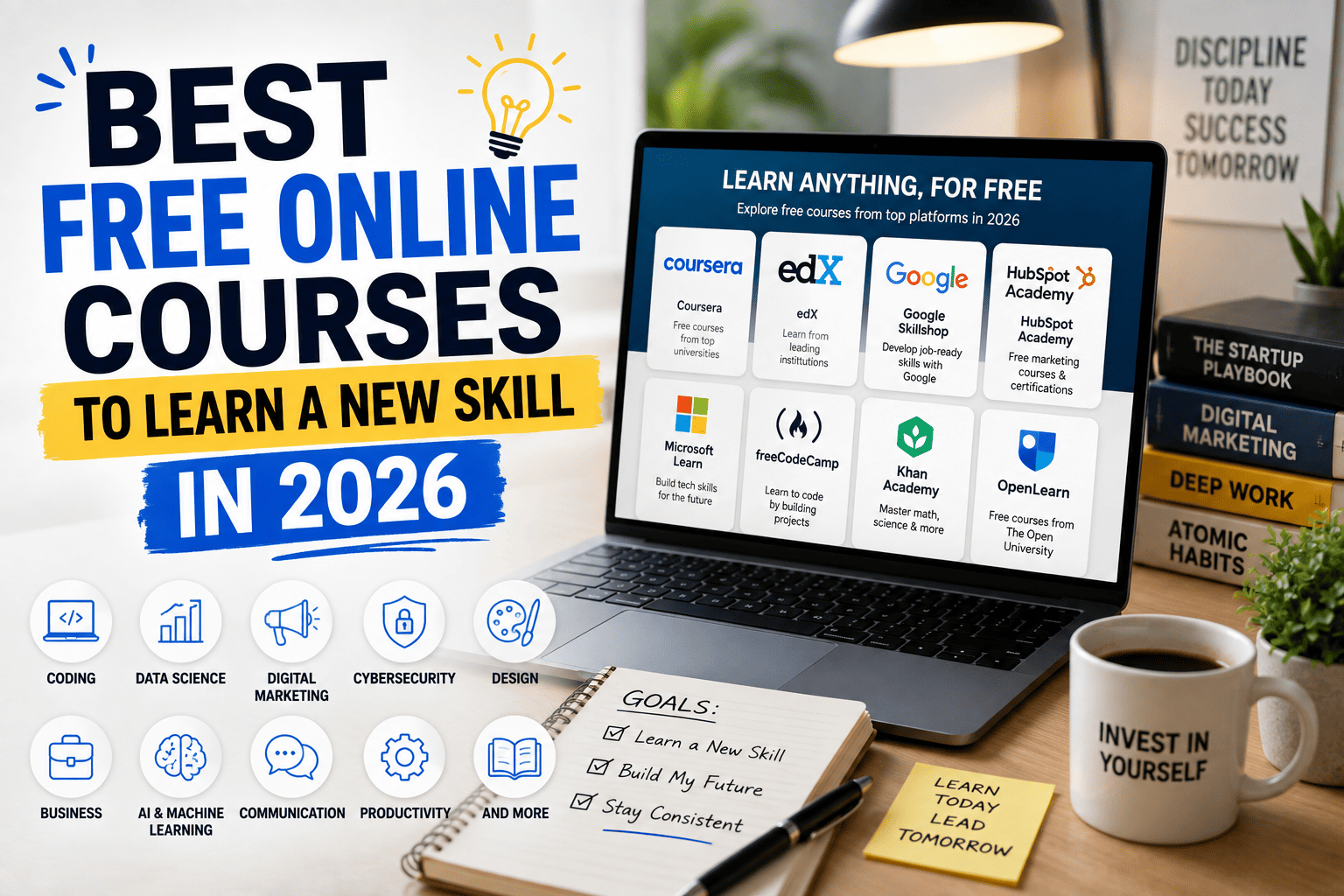
Learning a new skill no longer requires an expensive degree, classroom programme, or large training budget. In 2026, students, professionals, business owners, and job seekers can access useful lessons from universities, technology companies, and specialist learning platforms.
However, not every course advertised as free provides complete access. Some platforms offer only the first module, while others let you study for free but charge for certificates or assessments.
The best free online courses to learn skills provide structured lessons, practical activities, and a clear learning outcome without requiring immediate payment. Depending on your goal, you can study coding, artificial intelligence, digital marketing, cybersecurity, mathematics, business, data analysis, communication, or personal development.
This guide explains the best options available in 2026 and how to choose a course that delivers practical value.
What Does “Free Online Course” Mean in 2026?
The word “free” can have several meanings on online learning platforms.
A course may offer:
- Completely free lessons and assessments
- Free learning with a free certificate
- Free course access but a paid certificate
- Free access to selected modules only
- A short free trial before a subscription begins
- Financial assistance for eligible learners
Therefore, check the enrolment page before starting. Look for information about course access, assignments, deadlines, assessments, certificates, and subscription charges.
Course availability and pricing can change. The recommendations below reflect information available in August 2026.
1. HubSpot Academy Digital Marketing Certification
Best for: Digital marketing beginners, business owners, freelancers and marketing professionals
HubSpot Academy is one of the strongest platforms for learning digital marketing without paying for training or certification.
Its Digital Marketing Certification covers essential areas such as digital strategy, content, search engine optimisation, email marketing, social media and performance measurement.
HubSpot currently lists its Digital Marketing Certification as a three-hour programme. Its other free options include Content Marketing, Social Media Marketing, Digital Advertising, Inbound Marketing, Inbound Sales and Revenue Operations. The courses and certificates are completely free and online. (HubSpot Academy)
Skills You Can Learn
- Digital marketing strategy
- Content creation
- SEO fundamentals
- Social media marketing
- Email marketing
- Lead generation
- Inbound sales
- Digital advertising
Why It Is Worth Taking
The lessons are concise and designed around practical business situations. After passing the required assessment, learners can earn a certificate and add it to their LinkedIn profile.
This is an excellent choice for beginners who want free online courses to learn skills that can be applied to employment, freelancing or business growth.
2. Microsoft Learn
Best for: Artificial intelligence, cloud computing, Microsoft 365, Azure, data and business technology
Microsoft Learn provides free, self-paced technical training for beginners and experienced professionals.
Learners can explore individual modules or follow structured learning paths. Available subjects include artificial intelligence, Azure, Microsoft Copilot, security, data management, Power Platform and Microsoft 365.
Microsoft states that its Learn training is free and available to anyone. An account is not required to view the training, although signing in allows learners to save progress, collect achievements and access selected labs and challenges. (Microsoft Learn)
Recommended Learning Areas
- Fundamentals of generative AI
- Microsoft Azure fundamentals
- Microsoft 365 applications
- Cybersecurity and identity
- Data analysis
- Power Platform
- Cloud infrastructure
- Microsoft Copilot
Certificate Information
Completing modules can unlock achievement badges on a Microsoft Learn profile. However, official Microsoft certification exams may involve separate requirements or fees. (Microsoft Learn)
Microsoft Learn is particularly useful for professionals who work with Microsoft products or want to enter cloud, AI, data or IT roles.
3. Google Skillshop
Best for: Google Ads, Google Analytics and digital advertising tools
Google Skillshop provides self-paced product training created by Google experts.
The platform covers Google Ads, Google Analytics, Google Marketing Platform, Google Business Profile, Google Ad Manager, AdMob and other advertising products. Learners can study how these tools work and prepare for relevant Google product certifications. (Skillshop)
Skills You Can Develop
- Search advertising
- Display advertising
- Video advertising
- Campaign measurement
- Google Analytics
- Conversion tracking
- Advertising campaign optimisation
- Google Business Profile fundamentals
Who Should Take These Courses?
Google Skillshop is useful for digital marketers, agency professionals, freelancers, business owners and students preparing for marketing roles.
The courses focus heavily on Google’s own products. Therefore, combine them with broader marketing lessons from HubSpot Academy or another platform.
4. freeCodeCamp
Best for: Web development, programming and practical coding projects
freeCodeCamp is one of the best completely free platforms for people who want to learn coding.
Instead of relying only on video lessons, the platform teaches through coding challenges and practical projects. Learners can work towards verified certifications while developing examples for a coding portfolio.
freeCodeCamp states that every part of its learning platform is free. Learners study through challenges, build projects and earn verified certifications as they progress. (freeCodeCamp.github.io)
Popular Skills to Explore
- HTML and CSS
- Responsive web design
- JavaScript
- Front-end development
- Python
- Data analysis
- Databases
- APIs
- Information security
- Machine learning fundamentals
Its updated Python Certification was fully available by the end of 2025 and remained active in 2026. (The freeCodeCamp Forum)
Why It Is Worth Taking
freeCodeCamp is ideal for learners who prefer practising instead of watching long lectures. Its project-based structure also helps learners build work they can show to potential employers or clients.
5. CS50’s Introduction to Computer Science on edX
Best for: Beginners seeking a deeper introduction to computer science
CS50 is Harvard University’s well-known introductory computer science course. It is suitable for ambitious beginners who want to understand programming, algorithms, data structures and computational thinking.
Learners can access CS50 through edX and choose a free audit track. A verified edX certificate normally requires a paid upgrade. (edX)
Topics Commonly Covered
- Computational thinking
- Algorithms
- Data structures
- C programming
- Python
- SQL
- Web development
- Problem-solving
What to Consider
CS50 can be more demanding than short introductory coding courses. It requires consistent practice and problem-solving.
Choose freeCodeCamp when you want a gradual, project-based path. Choose CS50 when you want a more academic introduction to computer science.
6. Cisco Skills for All
Best for: Cybersecurity, networking, Python and entry-level technology skills
Cisco Skills for All provides free, practice-focused courses connected to technology career paths.
The platform offers introductory and career-focused learning in cybersecurity, networking, Python and data science. Cisco describes the courses as free online training backed by its technical expertise. (SkillsForAll)
Recommended Areas
- Introduction to Cybersecurity
- Networking Basics
- Python Essentials
- Data Science
- Junior Cybersecurity Analyst skills
- Network Technician skills
Why It Is Useful
Cisco’s courses are suitable for people considering careers in networking, IT support or cybersecurity.
Some learning paths can also help learners prepare for Cisco certification exams. The training may be free, but separate professional certification exams can have their own fees and requirements.
7. Khan Academy
Best for: Mathematics, economics, computing, science and academic foundations
Khan Academy is an excellent option for learners who need to strengthen foundational knowledge before starting an advanced professional course.
The platform provides free videos, articles, lessons and practice exercises. Subjects include mathematics, computing, economics, financial literacy, science, history and early college material. (Khan Academy)
Khan Academy India also provides free Grade 1–12 learning aligned with the Indian curriculum in English, Hinglish, Hindi, Punjabi and several other Indian languages. (Khan Academy India)
Best Uses
- Improving mathematics
- Learning financial literacy
- Reviewing economics
- Preparing for academic examinations
- Strengthening science fundamentals
- Beginning computer programming
- Filling gaps before an advanced course
Khan Academy is not primarily a professional certification platform. Its main value comes from building strong knowledge through structured practice.
8. OpenLearn by The Open University
Best for: University-style short courses and exploring new subjects
OpenLearn is the free learning platform operated by The Open University.
It provides free courses across education, health, psychology, business, digital technology, languages, society, science and personal development. OpenLearn states that all courses on the platform are free to study. (The Open University)
Useful Course Areas
- Introduction to cybersecurity
- Leadership and management
- Psychology
- Education and teaching
- Digital skills
- Communication
- Health and wellbeing
- Languages
- Academic study skills
Some courses provide a Statement of Participation or digital badge after completion. However, availability depends on the particular course. (The Open University)
OpenLearn is useful when you want to explore a subject before investing in a longer qualification.
9. Saylor Academy
Best for: Business, computer science, mathematics and free completion certificates
Saylor Academy offers a broad catalogue of self-paced online courses.
Its current programme information lists more than 160 free courses across business, computer science, mathematics, English, history and other subjects. Learners can earn a free certificate of completion by passing a course’s final exam. (Saylor University)
Skills and Subjects Available
- Business administration
- Project management
- Computer science
- Communication
- Mathematics
- Economics
- English
- Professional development
Saylor also provides an optional route to earn recommended college credit through paid proctored examinations. This is separate from its free skill-development courses.
It is a strong option for learners who want structured courses and proof of completion without paying for a basic certificate.
10. Free edX Audit Courses
Best for: University-led courses in technology, business, science and communication
In addition to CS50, edX provides courses from universities and organisations across numerous subjects.
Many edX courses can be audited at no cost. The audit option generally includes access to lectures, readings and selected practice activities. Graded assignments and verified certificates may require a paid upgrade. (edX)
Current introductory options on edX include subjects such as:
- Spreadsheets
- Google Analytics
- HTML and CSS
- SQL
- Prompt engineering
- Figma
- GitHub
- Cybersecurity
- Finance
- Branding
- Marketing funnels
For example, edX offers introductory courses covering spreadsheets and Google Analytics with free learning options. (edX)
Always confirm whether the course has a free audit option before enrolling.
Are Coursera Courses Completely Free in 2026?
Coursera remains a valuable learning platform, but learners should read the enrolment terms carefully.
In 2026, many Coursera listings provide a free preview of the first module or a limited free trial rather than unrestricted access to an entire course. Full content, graded assignments and certificates may require payment, a subscription or approved financial aid. (Coursera)
Therefore, Coursera may still be useful, but it should not automatically be treated as a completely free platform.
How to Choose the Right Free Online Course
The large number of free online courses to learn skills can become overwhelming. Use the following method to select the right programme.
Choose One Clear Goal
Avoid choosing a course simply because the topic is popular.
Set a specific outcome, such as:
- Build a basic website
- Run a Google Ads campaign
- Understand cybersecurity fundamentals
- Learn spreadsheet formulas
- Improve business communication
- Create a data analysis project
- Prepare for a marketing role
Check the Course Level
Confirm whether the course is suitable for beginners, intermediate learners or experienced professionals.
Starting with an advanced course can create unnecessary frustration.
Review the Learning Format
Some people learn best through videos. Others prefer written lessons, quizzes, coding challenges or practical projects.
Choose a format you can follow consistently.
Confirm What Is Actually Free
Check whether the free option includes:
- Every lesson
- Exercises
- Assessments
- Projects
- A certificate
- Permanent access
- Downloadable material
Do not enter payment details for a free trial unless you understand when billing begins.
Select Courses With Practical Work
A certificate alone does not prove that you can apply a skill.
Choose programmes that help you create something useful, such as a website, advertising plan, spreadsheet, presentation, data dashboard, written project or coding application.
How to Complete an Online Course Successfully
Enrolling is easy. Completing the course requires a simple system.
Set a weekly schedule and choose fixed learning days. Even three sessions of 30 minutes can create steady progress.
Take brief notes, but avoid copying every sentence from the course. Focus on key ideas, processes and examples.
Most importantly, practise the skill immediately. Apply each major lesson to a personal project, mock assignment or real business situation.
After completing the course, create one piece of work that demonstrates what you learned.
Frequently Asked Questions
What are the best free online courses to learn skills in 2026?
Strong options include HubSpot Academy for marketing, Microsoft Learn for technology, freeCodeCamp for coding, Cisco Skills for All for cybersecurity, Khan Academy for foundational subjects and OpenLearn for university-style short courses.
Can I get a free certificate from an online course?
Yes. Platforms such as HubSpot Academy, freeCodeCamp and Saylor Academy provide free certification or completion options for eligible courses. Other platforms may charge separately for verified certificates.
Which free course is best for getting a job?
The best course depends on the role you want. Coding learners can consider freeCodeCamp, marketers can use HubSpot Academy and Google Skillshop, while technology learners can explore Microsoft Learn or Cisco Skills for All.
Are free online courses useful on a resume?
They can support a resume when they are relevant to the target role. Their value increases when you also include projects, practical examples or measurable results.
How many online courses should I take at once?
Start with one main course. Completing one programme and applying the skill is usually more useful than enrolling in several courses and finishing none.
How can I verify whether an online course is truly free?
Review the enrolment page and look for separate charges related to certificates, subscriptions, assessments, trials or premium assignments.
Final Thoughts
The best free online courses to learn skills make education more accessible, but free access should not be confused with effortless learning.
Choose one skill that supports your career, studies, business or personal goals. Then select a course with structured lessons and practical exercises.
HubSpot Academy and Google Skillshop are strong choices for marketing. Microsoft Learn and Cisco Skills for All support technology learning. freeCodeCamp and CS50 are valuable for programming, while Khan Academy and OpenLearn cover a wider range of academic and personal subjects.
Do not collect courses simply to earn certificates. Complete the lessons, practise regularly and create evidence of what you can do.
For more practical education, career, technology and skill-development guides, explore Insight Rob Media.