
Quick Answer: What Happened to PHP in October 2026?
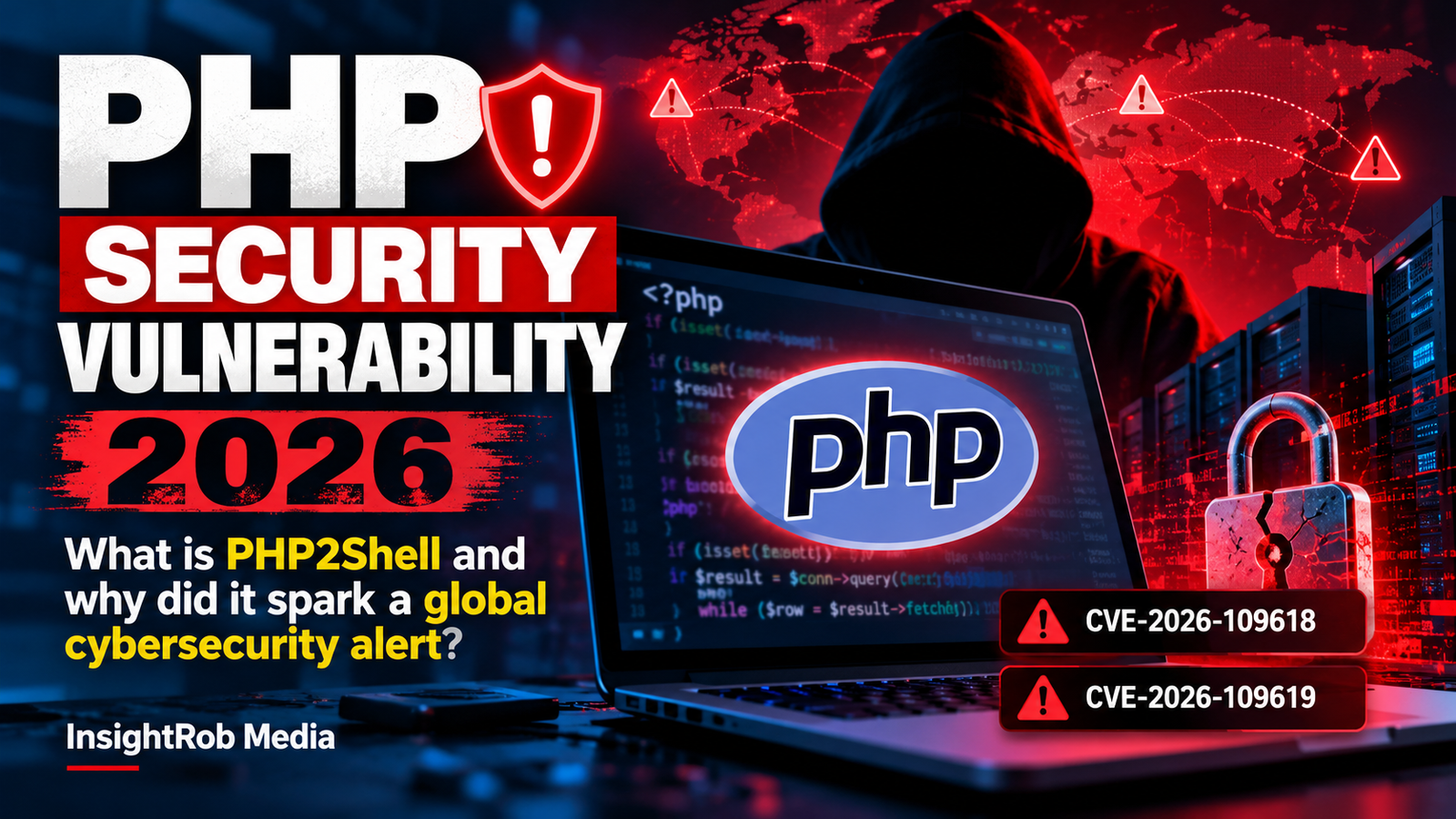
Two critical security vulnerabilities, identified as CVE-2026-109618 and CVE-2026-109619, were discovered in PHP, one of the most widely used programming languages for websites. The vulnerabilities, collectively referred to as PHP2Shell, could allow attackers to execute malicious code on vulnerable web servers without logging in. Both received a critical severity score of 9.2 under CVSS v4.0.
On October 21, 2026, the PHP development team released emergency security updates. Cybersecurity authorities worldwide advised website owners to install the fixes immediately.
Introduction: Why Is the PHP Security Issue Making Global Headlines?
On October 21, 2026, a serious cybersecurity warning sent website administrators, technology companies, and government agencies into emergency response mode.
The problem involved PHP, a programming language operating behind many websites, online stores, blogs, and web applications.
The issue attracted international attention after researchers identified two critical vulnerabilities in PHP’s underlying execution engine. These weaknesses created a risk of remote attacks against websites running affected software versions.
Unlike a security issue affecting only one WordPress plugin or website, vulnerabilities in PHP itself can potentially affect many different applications.
News organizations, including the BBC and Reuters, reported that some government and other public-facing websites were temporarily taken offline as administrators responded to the warning.
The incident also highlighted an emerging cybersecurity question: How can artificial intelligence help security researchers discover dangerous software vulnerabilities before attackers exploit them?
This InsightRob Media guide explains what happened, how the PHP vulnerabilities work, which websites may be affected, and what website owners should do to remain protected.
What Is PHP, and Why Is It Important for Websites?
PHP stands for PHP: Hypertext Preprocessor. It is an open-source, server-side scripting language commonly used to create dynamic websites and web applications.
When someone visits a PHP-based website, the server executes PHP code to prepare the information requested by the visitor. The server then sends the resulting webpage to the user’s browser.
PHP performs several essential tasks, including:
- Processing website forms and user requests.
- Connecting web applications with databases.
- Supporting login and authentication systems.
- Managing shopping carts and customer accounts.
- Generating dynamic pages and website content.
- Powering content management systems and business applications.
Popular technologies such as WordPress, Drupal, Joomla, and Laravel depend on PHP.
As a result, a serious flaw in PHP can create risks across numerous websites, even when their application code is otherwise well maintained.
What Are the Two Critical PHP Vulnerabilities Discovered in 2026?
The October 2026 PHP security alert concerns two distinct vulnerabilities. Both could result in unauthenticated remote code execution under vulnerable conditions.
1. CVE-2026-109618: Out-of-Memory Corruption
This vulnerability concerns how PHP handles certain memory allocation failures.
In some circumstances, PHP may interrupt a request while its internal data is incompletely initialized. During subsequent cleanup, the software may incorrectly process invalid memory.
An attacker who can trigger the vulnerable conditions may be able to exploit the resulting memory corruption.
2. CVE-2026-109619: Stale Global State
The second vulnerability involves internal PHP state that can retain references to memory after that memory has been released.
When another request uses the same worker process, it may encounter this invalid state.
Under exploitable conditions, the error could allow malicious code execution.
These are vulnerabilities inside PHP’s engine rather than ordinary mistakes in a website’s theme or content.
2026
+1
PHP vulnerability details at a glance
| Security detail | Information |
|---|---|
| Vulnerability names | CVE-2026-109618 and CVE-2026-109619 |
| Common name | PHP2Shell |
| Severity | Critical |
| CVSS v4.0 score | 9.2/10 for each vulnerability |
| Main threat | Unauthenticated remote code execution |
| Security fixes released | October 21, 2026 |
| Main protection | Install patched PHP releases |
What Is PHP2Shell, and How Can It Affect a Website?
PHP2Shell is the name associated with the two critical PHP vulnerabilities.
The most serious potential outcome is remote code execution (RCE).
Remote code execution means an attacker may be able to make a vulnerable server execute instructions that the website owner never authorised.
When the attack does not require authentication, the attacker may not need a username, password, or administrator account.
A successful attack could potentially result in:
- Unauthorised access to a website or server.
- Theft of sensitive information.
- Modification or deletion of website files.
- Installation of malicious programs.
- Website defacement or service disruption.
- Compromise of connected systems, depending on the server’s permissions and configuration.
However, an affected PHP version does not automatically mean that a website has already been hacked. It means the website may be exposed to exploitation.
Security teams must distinguish between vulnerability, attempted exploitation, and confirmed compromise.
Which PHP Versions Are Affected by the October 2026 Security Issue?
According to PHP’s official October 21 security advisory, administrators should upgrade to the following patched releases.
| PHP version branch | Minimum fixed version |
|---|---|
| PHP 8.5 | 8.5.12 |
| PHP 8.4 | 8.4.27 |
| PHP 8.3 | 8.3.36 |
| PHP 8.2 | 8.2.35 |
| PHP 8.1 and older | End-of-life; migrate to a supported release or obtain verified vendor-backed fixes |
The official PHP advisory identifies web-serving installations using PHP-FPM, Apache with mod_php, php-cgi, FrankenPHP, and LiteSpeed as potentially exposed.
Importantly, PHP 8.1 and older versions no longer receive standard upstream security updates. Certain Linux distributions and long-term-support vendors may provide backported fixes.
Website administrators should confirm their exact installed package and applicable vendor advisory rather than relying only on a version number.
Why Did the PHP Vulnerability Trigger a Global Cybersecurity Emergency?
Several factors made this PHP security issue particularly serious.
PHP powers a major share of the internet
PHP supports an enormous number of websites and online applications.
A weakness in its underlying engine can therefore affect multiple content management systems and frameworks simultaneously.
Attackers may not need login credentials
The vulnerabilities can allow unauthenticated remote code execution. This increases the potential danger because vulnerable public-facing servers may be reachable by attackers without existing accounts.
Exploit techniques have become public
Security authorities reported that proof-of-concept exploitation techniques were circulating after disclosure.
New Zealand’s National Cyber Security Centre also reported awareness of active exploitation on October 22, 2026.
Emergency fixes require operational changes
Updating PHP is not always as simple as clicking one button.
Businesses may operate older themes, plugins, frameworks, or custom applications. These components sometimes require compatibility testing before production systems can safely move to a newer PHP release.
For organisations unable to apply the necessary patches, authorities advised considering temporary isolation or shutdown of vulnerable internet-facing systems.
How Did Artificial Intelligence Help Discover the PHP Security Flaws?
One of the most interesting aspects of the PHP cybersecurity incident is the role of artificial intelligence.
According to reporting by the BBC and Reuters, AI-assisted security research helped identify the vulnerabilities.
Security researchers increasingly use AI systems to examine software code, identify unusual execution paths, and investigate potential weaknesses.
In traditional security research, specialists review code and test programs for flaws. AI tools can assist by analysing large quantities of code and suggesting areas that deserve closer inspection.
However, AI does not eliminate the need for human expertise.
Security professionals must still validate findings, assess whether vulnerabilities can be exploited, and coordinate responsible disclosure.
Why does this matter for future cybersecurity?
AI-assisted vulnerability research could change software security in several ways:
- Faster vulnerability discovery: Researchers may find certain programming errors more efficiently.
- Improved code analysis: AI can assist specialists investigating complex software.
- Earlier security fixes: Responsible discovery may give maintainers opportunities to release patches before widespread attacks.
- New security challenges: Malicious actors could also use AI to accelerate parts of their research.
- Greater need for security monitoring: Businesses may need faster patch-management and incident-response processes.
The PHP incident demonstrates why organisations should treat AI as both a cybersecurity opportunity and a technology that can change the threat landscape.
Are WordPress Websites Affected by the PHP Vulnerability?
Yes. WordPress websites running vulnerable PHP installations may be affected by the October 2026 security issue.
WordPress is built using PHP, meaning the underlying PHP runtime is an essential part of how a WordPress website operates.
Even when the WordPress core, themes, and plugins are updated, an outdated PHP installation can still create security exposure.
However, not every WordPress website has been compromised, and a website using WordPress is not automatically vulnerable if its PHP environment has already been appropriately patched.
Does updating WordPress fix PHP2Shell?
No. Updating WordPress and updating PHP are separate maintenance tasks.
A WordPress core update does not automatically guarantee that the hosting server has installed the necessary PHP security patch.
Website owners must confirm that their hosting provider has deployed the corrected PHP software.
This distinction is particularly important for website owners using shared hosting, managed WordPress hosting, or older servers.
How to Check Whether Your WordPress Website Is Using a Vulnerable PHP Version
If you operate a WordPress website, checking its PHP version is a useful first step.
Step 1: Open your WordPress dashboard
Log in to your website’s WordPress administration panel.
Step 2: Navigate to Site Health
Go to Tools → Site Health → Info.
Step 3: Check the Server section
Expand Server and locate the PHP version information.
Step 4: Verify the installed security patch
Compare your PHP version with the official fixed releases. Ask your hosting provider if it has installed a backported security fix.
Step 5: Update safely and test
Back up your website, coordinate the PHP update with your host, and verify that important pages and functionality still work.
A hosting dashboard may offer PHP version selection, but the selected version alone does not always confirm whether the underlying server package includes a security patch.
How to Protect Your Website From the PHP2Shell Vulnerability
The most important action is to apply the official PHP security fixes.
What if the PHP security update cannot be installed immediately?
PHP’s official security team states that updating to a fixed version is the only complete remediation.
Temporary server-level mitigations may reduce exposure in some environments, but they do not guarantee safety.
If immediate patching is impossible, organisations should consult their hosting provider or security team and consider restricting public access to vulnerable systems.
This may include temporary isolation or downtime until the necessary update is applied.
For public-facing servers, an organisation should also investigate signs of compromise. Installing a patch does not necessarily remove malicious software that an attacker may have installed earlier.
2026
+1
How Can Website Owners Identify Possible Signs of a PHP Security Attack?
Security incidents do not always create visible symptoms. Nevertheless, certain changes may warrant further investigation.
Potential warning signs include:
- Unfamiliar administrator accounts or unexpected permission changes.
- Unknown PHP files appearing inside website directories.
- Unexplained changes to website content or redirects.
- Unexpected outgoing traffic from the server.
- Suspicious server processes or unusual log entries.
- Unauthorised file modifications or new scheduled tasks.
- Security monitoring tools reporting suspicious activities.
These symptoms are not proof that PHP2Shell was exploited. They can also have other explanations.
Website owners who suspect compromise should preserve relevant logs, contact their hosting provider, and arrange an appropriate security investigation.
For WordPress websites, a malware scan can help identify suspicious files. However, a clean WordPress scan cannot establish that the underlying server is free of compromise.
Is the PHP Vulnerability a Risk for Online Stores and Business Websites?
The PHP vulnerability may have significant implications for businesses relying on web applications.
E-commerce platforms, customer portals, online booking systems, and content management systems may all rely on PHP.
If attackers exploit a vulnerable server successfully, the consequences could include business interruption, website manipulation, or unauthorised access to stored information.
However, the severity of the actual impact depends on multiple factors, including server configuration, access permissions, and whether an attacker successfully exploited the weakness.
Businesses should prioritise applications handling personal information, transactions, or critical operations.
For WooCommerce and other WordPress-based e-commerce websites, it is especially important to verify PHP patch status and test checkout functionality following the update.
What Has India’s CERT-In Said About the PHP Security Issue?
India’s Computer Emergency Response Team, known as CERT-In, published a critical vulnerability note on October 21, 2026.
The advisory, CIVN-2026-0510, identifies the remote code execution vulnerabilities in PHP and describes the potential risk of complete system compromise.
It identifies affected PHP 8.2, 8.3, 8.4, and 8.5 releases before their respective patched versions.
CERT-In recommends applying security updates and mitigations from the official PHP project.
Indian businesses, government organisations, hosting providers, and website owners using PHP should review the advisory and verify their exposure.
CERT-IN
Should Businesses Stop Using PHP After the 2026 Cybersecurity Alert?
The discovery of these vulnerabilities does not mean organisations must abandon PHP.
PHP remains an established programming language with a large developer ecosystem and widespread commercial adoption.
Software vulnerabilities can occur in many programming languages and platforms.
The important question is how quickly developers, vendors, and website operators can identify and remediate security weaknesses.
For existing PHP applications, organisations should focus on supported software versions, security patches, secure development practices, and continuous maintenance.
Security should be treated as an ongoing process rather than a one-time website setup activity.
How to Build a More Secure PHP Website in 2026 and Beyond
The PHP2Shell incident offers several practical lessons for developers and organisations.
Keep the PHP runtime updated. Maintain an inventory of PHP applications and establish a process for monitoring security releases.
Use maintained frameworks and dependencies. Avoid relying on unsupported packages or obsolete application components.
Follow secure coding practices. Validate inputs, apply appropriate authentication and authorisation, and avoid unnecessary exposure of sensitive information.
Apply least-privilege access. Restrict permissions for applications, database accounts, and server processes.
Review logs and maintain backups. Reliable recovery plans and monitoring systems can improve an organisation’s response to unexpected security incidents.
Test updates before deployment. Staging environments can help identify compatibility problems, especially for e-commerce websites and custom PHP applications.
Stay informed through authoritative advisories. Follow PHP’s official security announcements and trusted national cybersecurity agencies rather than relying on unverified social media claims.
These practices cannot eliminate every security risk, but they can improve overall website resilience.
Frequently Asked Questions About the PHP Security Vulnerability 2026
1. What is the PHP security vulnerability in 2026?
The October 2026 PHP security issue involves two critical vulnerabilities, CVE-2026-109618 and CVE-2026-109619. Under vulnerable conditions, attackers may execute unauthorised code on affected PHP servers.
2. What is PHP2Shell?
PHP2Shell is the name associated with the two critical PHP vulnerabilities disclosed in October 2026. They involve memory-handling problems that can potentially enable remote code execution.
3. Is PHP safe to use in 2026?
Yes, PHP can still be used to develop websites and applications. However, organisations must install the latest applicable security patches, use maintained software, and follow secure development practices.
4. Does the PHP security issue affect WordPress?
WordPress websites may be affected if they run vulnerable PHP versions. Updating WordPress alone does not guarantee that the underlying PHP software has been patched.
5. How do I fix the PHP2Shell vulnerability?
Install a patched PHP release, such as PHP 8.5.12, 8.4.27, 8.3.36, or 8.2.35, as appropriate for your supported version branch. Confirm any vendor-specific backported fixes with your hosting provider.
6. Can hackers access websites without passwords using PHP2Shell?
Successful exploitation may allow attackers to execute code without prior authentication. However, vulnerability exposure does not automatically indicate that a website has been compromised.
7. Did artificial intelligence discover the PHP vulnerability?
AI-assisted cybersecurity research played a role in finding the vulnerabilities, according to reports about the October 2026 discovery. Human researchers also played an essential role in validation and disclosure.
8. Can PHP2Shell affect WooCommerce websites?
Yes. WooCommerce operates on WordPress, which uses PHP. WooCommerce websites running an affected PHP environment may be exposed, even if their plugins are updated.
9. Can a firewall completely prevent PHP2Shell attacks?
No. A firewall may help restrict certain attack paths, but the official PHP advisory makes clear that installing the security patch is the only complete remediation.
10. What should I do if my website uses an outdated PHP version?
Identify the installed version, contact your hosting provider, back up the website, and arrange a security update. If the version is no longer supported, plan a migration to a maintained release.
11. Has the PHP vulnerability been fixed?
Yes. The PHP development team released security fixes on October 21, 2026. However, individual websites remain potentially exposed until their affected installations are appropriately patched.
12. Where can I find official PHP vulnerability updates?
You can monitor PHP.net, national cybersecurity agency websites, and relevant hosting vendor advisories for current security information.
Conclusion: What the PHP Cybersecurity Alert Means for the Future of Website Security
The PHP security vulnerability discovered in October 2026 highlights how vulnerabilities in widely used software can create international cybersecurity concerns.
Two critical flaws, CVE-2026-109618 and CVE-2026-109619, prompted emergency software updates and responses from governments, cybersecurity agencies, and website operators.
The incident also demonstrated the increasing role of artificial intelligence in identifying complex software vulnerabilities.
For website owners, developers, and businesses, the most important lesson is clear: regular security maintenance is essential, even when a website appears to be functioning normally.
Checking PHP versions, installing verified patches, maintaining secure backups, and monitoring server activity can help reduce cybersecurity exposure.
At InsightRob Media, our goal is to make important technology developments understandable through accurate, practical, and educational information.
Official sources and further reading
The article draws on verified information available as of October 22, 2026.