










Studying for hours does not always guarantee better results. The way you study can be just as important as the amount of time you spend studying.
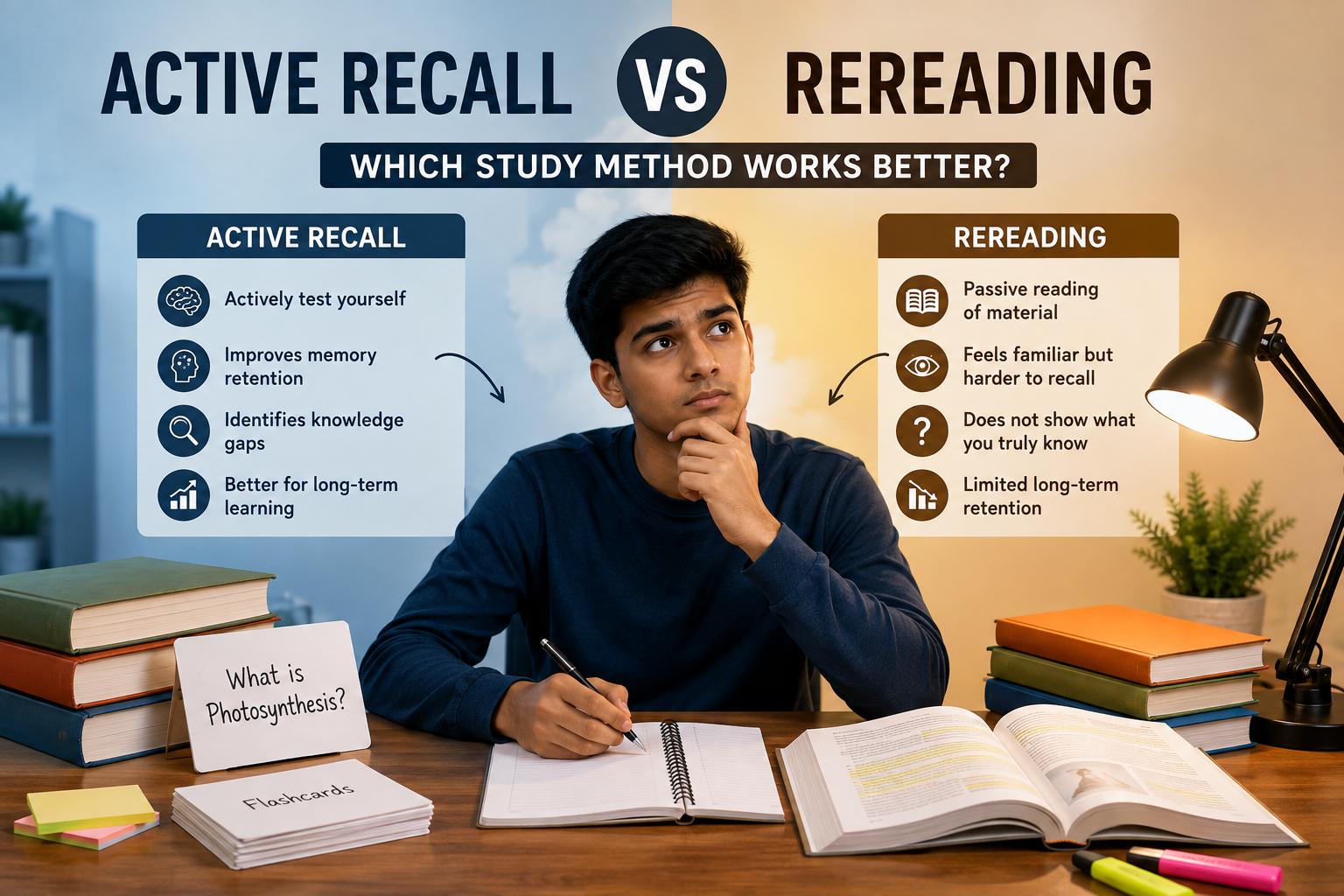
Two common approaches students use are active recall and rereading. Rereading feels simple because you review the same material repeatedly. However, the Active Recall Study Method requires you to actively retrieve information from memory.
So, which technique actually works better?
Research on learning and memory has repeatedly highlighted the importance of retrieval practice. Active recall can make studying more engaging while also helping students identify what they genuinely understand and what still needs improvement.
Let’s understand both methods and compare their effectiveness.
What Is the Active Recall Study Method?
The Active Recall Study Method is a learning technique where you actively try to remember information without looking at your notes, textbook, or study material.
Instead of simply reading the same chapter again, you challenge your brain to retrieve the information.
For example, after studying a chapter, you might close the book and ask yourself:
- What were the main concepts?
- Can I explain this topic without looking at my notes?
- What important definitions do I remember?
- Can I answer practice questions about the topic?
This process forces your brain to retrieve information rather than simply recognize it.
Retrieval practice can strengthen memory and make it easier to access information later, particularly during exams.
What Is Rereading?
Rereading is one of the most common study methods.
It involves reading the same chapter, notes, or study material multiple times to become more familiar with the content.
For example, a student might read a history chapter once and then read it two or three more times before an examination.
Rereading can help students become familiar with a subject. However, familiarity does not necessarily mean that the information can be recalled independently.
You may recognize information when looking at your notes but struggle to remember it when the notes are removed.
That is one of the main differences between rereading and active recall.
Active Recall vs Rereading: Key Differences
| Factor | Active Recall | Rereading |
|---|---|---|
| Learning Style | Active | Passive |
| Main Process | Retrieving information | Reviewing information |
| Memory Engagement | High | Comparatively lower |
| Identifies Knowledge Gaps | Yes | Difficult |
| Suitable for Exam Preparation | Highly useful | Useful mainly for initial review |
| Requires Mental Effort | Higher | Lower |
| Long-Term Retention | Generally stronger | Can be limited without retrieval |
| Best Used With | Spaced repetition | Active recall and note-taking |
Both methods can have a place in studying. However, they serve different purposes.
Rereading can help during the first stage of understanding a topic. Active recall becomes particularly valuable after you have studied the material.
Why Does Active Recall Work?
Active recall works because remembering information is itself a form of practice.
When you try to retrieve something from memory, your brain has to actively access previously learned information.
Repeated retrieval can make that information easier to recall in the future.
Think of it like practising a skill.
Reading about swimming is different from actually swimming. Similarly, reading an answer repeatedly is different from practising how to produce that answer from memory.
The Active Recall Study Method creates conditions closer to an actual examination because students usually have to produce answers without their textbooks in front of them.
Why Rereading Can Feel Effective
One reason students frequently depend on rereading is that it feels comfortable.
After reading the same material several times, the information begins to look familiar.
That familiarity can create the impression that you have mastered the topic.
However, recognition and recall are different abilities.
For example, you might recognize the definition of a scientific term immediately when you see it. But if someone asks you to explain the definition without looking at the textbook, you may struggle.
This difference is important when preparing for exams.
Most examinations test your ability to recall, explain, analyse, or apply information rather than simply recognize it.
Benefits of the Active Recall Study Method
1. Helps Improve Memory Retention
Repeatedly retrieving information encourages the brain to strengthen access to that information.
Instead of repeatedly exposing yourself to the same material, you practise actually remembering it.
2. Identifies Weak Areas
Active recall quickly reveals what you do not know.
If you cannot answer a question without checking your notes, the topic may need additional revision.
This allows you to focus your study time more efficiently.
3. Encourages Active Learning
Passive studying can make it easy to lose concentration.
Active recall requires participation.
You constantly ask questions, explain ideas, solve problems, and test your memory.
4. Supports Exam Preparation
Most exams require students to retrieve information independently.
Practising retrieval while studying can therefore make revision more similar to the conditions students experience during an examination.
5. Makes Revision More Focused
Instead of rereading an entire chapter several times, students can identify difficult concepts and spend more time reviewing those specific areas.
How to Use Active Recall While Studying
You do not need complicated tools to use active recall.
Several simple techniques can make it part of your regular study routine.
Create Questions From Your Notes
After studying a topic, turn important information into questions.
For example:
Instead of writing:
“Photosynthesis converts light energy into chemical energy.”
Create a question:
“What happens to light energy during photosynthesis?”
Then try to answer it without looking at the original notes.
Use Flashcards
Flashcards are one of the easiest ways to practise active recall.
Write a question, keyword, or concept on one side and the answer on the other.
Try answering before checking the reverse side.
Digital flashcard applications can also be useful when combined with spaced repetition.
Use the Blank Page Method
Study a topic and then close your notes.
Take a blank sheet of paper and write everything you remember.
Afterwards, compare what you wrote with the original material.
This makes knowledge gaps easy to identify.
Explain the Topic Without Notes
Try explaining a concept as if you were teaching another person.
Do not look at your textbook while explaining it.
If you become stuck, identify the missing information, review it, and try again.
Solve Practice Questions
Practice questions, previous exam papers, and self-created quizzes are effective forms of retrieval practice.
Instead of immediately checking the solution, try solving the question independently first.
Active Recall and Spaced Repetition
Active recall becomes even more useful when combined with spaced repetition.
Spaced repetition means reviewing information at gradually increasing intervals rather than studying everything repeatedly in one session.
For example, you might review a topic:
- On the day you learn it
- A few days later
- One week later
- Two weeks later
- Again before the examination
During each review session, use active recall instead of simply reading the material again.
This combination allows students to repeatedly practise retrieving information over time.
Can You Use Rereading With Active Recall?
Yes.
Rereading does not need to be completely removed from your study routine.
The important point is how you use it.
You might first read a chapter carefully to understand the material. Then close the book and test yourself.
If you cannot remember an important concept, return to that section, review it, and test yourself again.
A practical study sequence could look like this:
Read → Understand → Close the Book → Recall → Check → Review Weak Areas → Recall Again
This approach uses rereading as a supporting technique rather than the entire study strategy.
Active Recall Study Example
Suppose you are preparing for a biology exam.
You need to study the human digestive system.
Rereading Approach
You read the chapter three times and highlight important sentences.
The information feels familiar.
However, when someone asks you to explain the complete digestion process without the textbook, you forget several important steps.
Active Recall Approach
You read the chapter once carefully.
Next, you close the book and try to answer questions such as:
- Where does digestion begin?
- What is the function of the stomach?
- What role does the small intestine play?
- Which organs contribute digestive enzymes?
- How are nutrients absorbed?
You check your answers, identify mistakes, review those areas, and test yourself again.
The second method provides much clearer information about how well you actually know the topic.
Common Active Recall Mistakes
Active recall can be highly useful, but students sometimes use it incorrectly.
Checking Answers Too Quickly
Give yourself enough time to retrieve the answer before looking at your notes.
The effort involved in remembering is an important part of the process.
Memorising Without Understanding
Active recall should not become simple word-for-word memorisation.
Try to understand the concept and explain it in your own words.
Creating Too Many Flashcards
Hundreds of unnecessary flashcards can make revision overwhelming.
Focus on important concepts, definitions, formulas, relationships, and areas you frequently forget.
Ignoring Difficult Questions
Students sometimes repeat questions they already know because answering them feels rewarding.
Spend more time on questions you find difficult.
Which Is Better: Active Recall or Rereading?
For long-term learning and exam preparation, active recall generally provides greater learning value than relying only on repeated rereading.
However, this does not mean rereading has no purpose.
Rereading can help you become familiar with new information and understand difficult material during the first stage of studying.
The problem occurs when rereading becomes the only revision strategy.
A stronger approach is to use rereading for understanding and the Active Recall Study Method for testing and strengthening what you have learned.
How Students Can Build an Active Recall Routine
You can gradually introduce active recall into your daily study schedule.
After every study session, spend a few minutes testing yourself.
For example:
30 minutes: Learn a new topic
10 minutes: Recall the key points without notes
10 minutes: Check your answers and review weak areas
5 minutes: Test yourself again
You can then revisit the same questions after several days using spaced repetition.
The goal is not to remember everything perfectly during your first attempt.
The difficulty of retrieving information actually helps reveal what requires further practice.
Final Thoughts
Effective studying is not simply about spending more hours with books open.
It is about choosing methods that require your brain to work with the information.
Rereading can help students understand and become familiar with new material. However, repeatedly reading the same pages can sometimes create an illusion of mastery.
The Active Recall Study Method changes the process from passive review to active retrieval.
By asking questions, solving practice problems, using flashcards, explaining concepts, and testing yourself without notes, you can better understand what you genuinely know.
For students preparing for exams, combining active recall with spaced repetition can create a more structured and effective revision strategy.
Frequently Asked Questions
What is the Active Recall Study Method?
The Active Recall Study Method involves testing yourself and retrieving information from memory without immediately looking at your study material. Examples include flashcards, practice questions, self-quizzing, and explaining topics without notes.
Is active recall better than rereading?
Active recall is generally more effective for practising retrieval and identifying knowledge gaps. Rereading can still be useful when initially learning or reviewing difficult material.
How often should I practise active recall?
Active recall can be used after every study session and during later revision sessions. Combining it with spaced repetition can help organise reviews over longer periods.
Can active recall help with exam preparation?
Yes. Active recall closely matches what students often need to do during exams—retrieve information without access to books or notes.
What is the easiest active recall technique?
Self-questioning is one of the simplest methods. Study a topic, close your notes, and try to explain or write everything you remember before checking your answers.
Should I stop rereading completely?
No. Rereading can help when learning unfamiliar material or reviewing a concept you do not understand. However, it is usually better to combine rereading with retrieval-based study techniques.
Research References
Research on retrieval practice and learning has examined how testing, recall, and repeated retrieval can affect memory retention.
- Roediger & Karpicke: Research on test-enhanced learning and retrieval practice.
- Karpicke & Blunt: Research comparing retrieval practice with other study approaches.
- Research on retrieval-based learning: Studies examining how actively recalling information can support longer-term learning.
- Spaced learning research: Research exploring the benefits of distributing learning and retrieval across multiple study sessions.